

Question
I’m struggling to define “spiritualizing.” I get it on a surface level but it’s not a term I’ve heard used in my church settings. Can you give me some examples of it? How might someone spiritualized a text?

Response
In the very literalist tradition in which I was raised, we were told to read the Bible literally, and warned that “spiritualizing” the text was a no-no. I was taught to search for the “objective” meaning of a passage and that spiritualizing the Bible was dangerous because it was too “subjective.” Instead, we needed to find the meaning of the text through the scientific tools of hermeneutics (the study of interpretation).
So in that context, “spiritualizing” meant something like reading the Bible stories as allegory and applying them as if the Bible were addressing us. They said NO—the correct method was to work out what the author intended to say to his own audience, and only then could we apply those principles (secondhand) to our lives. So in that context, “spiritualizing” was seen as sloppy and dangerous because you could make the Bible mean whatever you wanted it to mean. It also meant that the pastor was the expert with the time and training to tell you the Bible’s authorized meaning (uh oh).
Of course, our actual practice was better than that because we were encouraged to read the Bible for ourselves every day. And our literal reading did include seeing “Old Testament typology”—Old Testament images that anticipated Christ and his Gospel. In other words, “spiritualizing” isn’t something we DO TO the Bible.
It’s a spiritual approach that penetrates through to the spiritual sense of the text,
namely, perceiving the gospel woven throughout by the Spirit.
“Spiritualizing” isn’t something we DO TO the Bible.
It’s a spiritual approach that penetrates through to the spiritual sense of the text,
namely, perceiving the gospel woven throughout by the Spirit.
And that is exactly what early church teachers, such as Origen, Gregory of Nyssa, and Gregory of Nazianzus called “the spiritual sense” of the text. For them, spiritualizing was simply seeing how any Bible story, character, or image are fulfilled in the Jesus story. This is laid out in The Philocalia of Origen, compiled by Basil the Great and Gregory of Nazianzus in the fourth century.
Benaiah in Origen’s Literal Sense
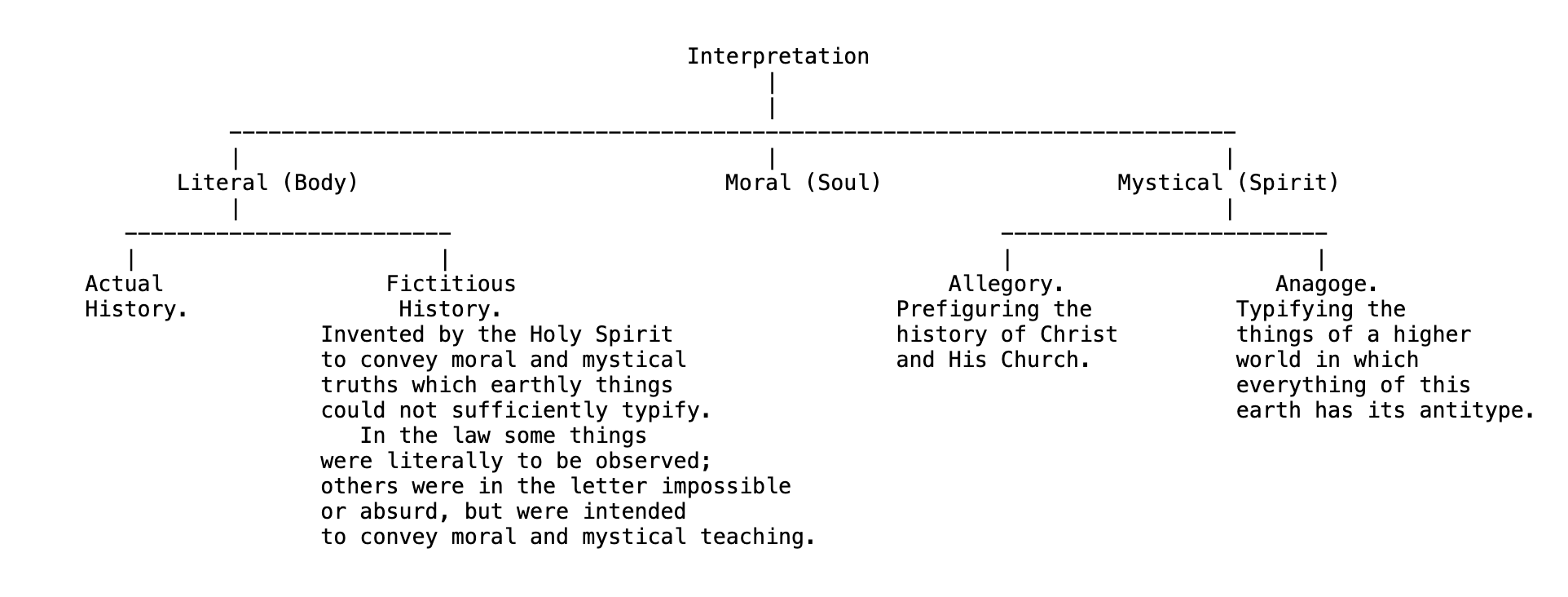
According to Origen and other early church fathers and mothers, yes, we do start with the literal (not literalist) sense, paying close attention to the words, grammar, context, etc., to get a sense of the author’s intent. That’s an important step and shouldn’t be skipped. We ask why the story is there in the first place, and how it functions in its historical and canonical context. The literal sense asks what it’s there for.
Let’s take an example from 1 Chronicles 11:22-23, which names one of David’s “mighty men” and his exploits.
Benaiah son of Jehoiada was a valiant man of Kabzeel, a doer of great deeds; he struck down two sons of Ariel of Moab. He also went down and killed a lion in a pit on a day when snow had fallen. And he killed an Egyptian, a man of great stature, five cubits tall. The Egyptian had in his hand a spear like a weaver’s beam, but Benaiah went against him with a staff, snatched the spear out of the Egyptian’s hand, and killed him with his own spear.
The literal sense of this text might seem to be simple history, honoring a military veteran. And what do we have? A man. A lion. A pit. A snowy day. A giant with a big spear. But why these stories? What is the author up to? On the surface, he’s recounting legends (the literal sense includes history and fiction) to show that David’s kingdom was built through the courage and loyalty of others. David dominates the story, but he didn’t accomplish everything himself. The compositor thinks these men deserve to be remembered by name.
Further, the story could serve as a kind of propaganda to call the tribes to unity (remember how the Davidic kingdom fractured) by staying loyal to David’s royal line. In that sense, it’s a warning (or rebuke in retrospect) to the northern tribes.
But also, I find it intriguing that in the earlier 2 Samuel 23 version, the list ends with “Uriah the Hittite” (23:39), the loyal soldier David arranged to have killed. That final name makes it difficult to read the parade of heroes as uncomplicated praise of David. All of those questions are aspects of the literal sense of authorial intent.
Benaiah in Origen’s Moral Sense
Then we move to the moral (not moralist) sense, asking ourselves how this text might help shape my spiritual formation, inspiring me toward more Christlike discipleship. How? It it by going on safaris and killing bad guys? No. That’s not the path of Christlike love we see in Jesus’ Sermon on the Mount. The moral sense transposes these images and events and characters into symbols so the story serves as a parable for our benefit of what to do or what not to do. Sometimes we look for symbolic or spiritual meanings in the etymology (root words) of the names (e.g. Behaiah = “Yahweh has built,” Joehoiada = son of “Yahweh knows,” and Kabzeel = “God has gathered.” Anything there? Maybe not… but I noticed “built” and “gathered” might coincide with the kingdom unity agenda.
My point is that the moral sense is often what people mean by “spiritualizing,” especially if we read the images symbolically. In the case of this story, I heard a memorable sermon on this focusing on the moral sense. The preacher compared the pit, the snow, the lion, and the giant to the challenges in our lives that we cannot overcome in our own strength. The preacher spoke eloquently about how this story inspired him to rely on God’s strength through his battle with depression. And if you think about it, this is typical of how many preachers employ the story of David and Goliath. What is the armour, what are the five stones, what is the Goliath, etc.?
Benaiah in Origen’s Spiritual (or Gospel) Sense
I think that’s valid. But for Origen and his spiritual progeny, the spiritual sense is something else. He uses the word “spiritual” because he wants to make an analogy between the human body and Scripture: body = literal, soul = moral, and spirit = spiritual.
The spiritual sense of the text asks how any story can be read as an image specific to the gospel. In this way, the early church could be said to “spiritualize” the text by retelling the gospel message using Old Testament texts. Irenaeus of Lyon (2nd century) wrote a whole book on it called The Demonstration of the Apostolic Preaching, full of examples of how Christian preachers would preach the gospel from the Old Testament. Click here for a link to a pdf of the book.
Because of the baggage around the term “spiritualize,” I tend to use another word for this layer of interpretation: “the gospel sense.” That sharpens the focus on exactly what we’re looking: how the gospel story is already embedded by the Holy Spirit (i.e., spiritually inspired) into all the Scriptures. The freedom, creativity, and even playfulness involved is intentional, but can make literalists nervous. They hope modernist method will lead them to the singular meaning of a text. That’s just not real. But on the Road to Emmaus, Jesus showed his disciples how the Law, the prophets, and all the Scriptures were a revelation that the Messiah must come, suffer, die, rise, and ascend to glory.
So in the story of the Benaiah, I see some beautiful and suggestive clues that give rise to gospel preaching. We begin by reading Benaiah as a lesser shadow of Christ. The story foretells Jesus’s entry into this cold, inhospitable world, then through his death, descends into the much deeper pit (the grave, sheol, hades), overcomes the much more dangerous lion (the devourer). In the second story, he faces and destroys the much great giant (the devil) using the enemy’s own much deadlier weapon (death), where the spear the size of a weaver’s beam can symbolize the cross. And so we preach that by death, Christ conquered death, and bestowed life to those in the tomb.
The reality of the gospel is always greater than the shadow it casts...
by the Spirit, as the people of God recount their legends,
they do so precisely because Christ is the awaited Messiah who fulfills them.
In this way, the reality of the gospel is always greater than the shadow it casts... meaning that by the Spirit, as the people of God recount their legends, they do so precisely because (with or without knowledge) Christ is the awaited Messiah who fulfills them.
I hope this explanation and example provide a template that you could apply throughout the Scriptures. In any case, Irenaeus’ book will provide many wonderful samples.
After having survived many spurious interpretations of BIBLICAL SCRIPTURES (always pronounced solemnly and in all caps) over my many years - I appreciate this concise summary of "how to read the bible," - thanks Brad. fwiw my first inkling that maybe Christians, in general, are having serious difficulties with this topic started sinking in when a wise pastor once raised the point for me that there are hundreds (or even thousands, depending how we count them) Christian Sects and Denominations -- all claiming to be following the same book. What's wrong with this picture? mmmm? .... Huumanz! right?
Thanks Brad.
Those who say that our reading of Scripture spiritualises the text accuse us of eisegesis, and speculate that we’re making the text say whatever we want.
But this is untrue. We can only see what the Holy Spirit opens our eyes to see, as we ask God to:
Psalm 119:18 KJV. Open thou mine eyes, that I may behold wondrous things out of thy law.
Different people see different things. An Omnisignificant Christocentric Theorian (a native of Alexandria, like Apollos) will see things that the Reformed Calvinist just doesn’t see, and vice versa. It comes down to one’s conviction of Scripture, and Paul warns us against judging another’s views.
Romans 14:4 ESV “Who are you to pass judgment on the servant of another? It is before his own master that he stands or falls. And he will be upheld, for the Lord is able to make him stand.”
Staying true to our convictions through a cleansed conscience is important for all Christians.
My take is that Benaiah the son of Jehoiada is typological of the Apostle Paul in Acts 23, where he divides the Pharisees and Sadducees against each other in the Sanhedrin (the two Ariels of Moab) and strikes down the High Priest with his own Law (spear) - the Egyptian, five cubits tall (referring to the Torah). And Paul shut the mouth of the lion on a day snow had fallen. The mouths of the 40+ men (the lion) who vowed not to eat or drink until they had killed Paul were permanently shut when judgement (snow) was pronounced against them by God.
Acts 23:11 ESV. The following night the Lord stood by him and said, "Take courage, for as you have testified to the facts about me in Jerusalem, so you must testify also in Rome."