


QUESTION: A Ransom to who?
I often hear that Christ died for my sins, gave Himself as a ransom, and “paid the debt.” What is your view on all of this? To whom did Christ pay this debt? To the Father? I know one verse says Christ purchased the church with His own blood. But purchased from whom?
RESPONSE: The Ransom Metaphor
Before I dive into my fuller response, one very surprising correction to the verse you cited. Here is what Paul actually said:
Be on guard for yourselves and for all the flock, among which the Holy Spirit has made you overseers, to shepherd the church of God which He purchased with His own blood. —Acts 20:28
That’s quite shocking because it identifies the blood with God (in the NT, almost always as a reference to the Father) rather than to Jesus. Later manuscript evidence sometimes opts for “which He purchased with the blood of [his] Own” … as in “his own Son,” which is theologically easier but also less likely textually. Some other time we can talk about the “communication of attributes,” where divine attributes are assigned to Christ’s humanity and human attributes are ascribed to deity. It’s at least poetic, and you can read more about that in Cyril of Alexandria’s That Christ is One (aka The Unity of Christ). But now to your question, an excerpt from A More Christlike God:
THE RANSOM: Excerpt from A More Christlike God
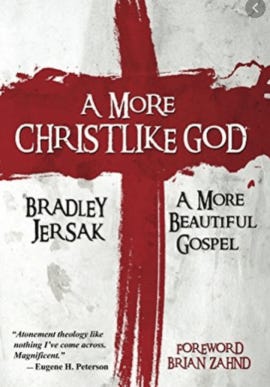
Jesus once said, “the Son of Man did not come to be served, but to serve, and to give his life as a ransom for many”(Mark 10:45). And Paul writes to Timothy that Jesus “gave himself as a ransom for all people” (1 Tim. 2:6).
In modern times, we associate ransoms with the demands of a kidnapper who wants payment for someone they hold in bondage. In this case, giving oneself in exchange for a prisoner, like we see in C. S. Lewis’s The Lion, the Witch and the Wardrobe, when Aslan gives himself over to the witch Jadis to be slain on the stone table in exchange for the life of Edmund. She is able to leverage this deal because under the law, someone must die. Again, seeing it this way can be a bit confusing, and in fact, it’s actually problematic on three counts. Specifically,
a. Was the ransom paid to God? If Christ’s life was given in ransom (or redemption), the church fathers reasoned that the ransom could not be paid to God, because God is not the slaveholder. The Book of Hebrews makes that clear: “by his death he [broke] the power of him who holds the power of death—that is, the devil—and free those who all their lives were held in slavery by their fear of death” (Heb. 2:14-15).
Lewis’s tale solves this problem because he doesn’t picture God requiring the payment. The witch is the one who demands punishment—a life for a life—leveraging the law of sin and death against Aslan. As in the New Testament, Aslan gives his own life and, in the end, “a deeper magic [self-giving love] from before the dawn of time” resurrects an innocent killed in place of a traitor.
b. Was the ransom paid to Satan? While some of the church fathers dabbled with this theory (i.e., a ransom paid to Satan), they ultimately reject this idea too. The truth, they said, is that God owes the devil—the thief—nothing. The prolific theologian Origen (182- 254 AD) starts out with a ransom to Satan, but like Lewis, treats Christ’s offering to Satan as a trap, where Jesus’ humanity is the bait. The devil takes the bait, but Christ’s divine nature and supernatural love overcome—it’s too hot to handle— and Jesus emerges from death along with all those Satan had held in his dungeon.
The truth is that Jesus utterly judged and defeated Satan on the Cross (John 12:31; 16:11; Col. 2:15). There’s no deal-making going on here. In another of his metaphors, Jesus said,
26 If Satan opposes himself and is divided, he cannot stand; his end has come. 27 In fact, no one can enter a strong man’s house without first tying him up. Then he can plunder the strong man’s house. —Mark 3:26-27
In this metaphor, there is no deal on the table, no careful trap being set. Jesus describes his ministry in terms of an overpowering home invasion where he storms Satan’s house, immobilizes him, binds him up and plunders his goods (namely, all those he had enslaved). This echoes the Exodus backstory, when God plundered Pharaoh of his slaves and Egypt’s gold (Exod. 12:36). Rather than paying Satan or Pharaoh, quite the reverse is true: he ransacks their territory and leaves them penniless.
A ransom?
Christ ‘gave his life as a ransom’ (Matt. 20:28). But to whom?
Not to God, for God is not the slave-holder.
Not to Satan, for God owes Satan nothing.
Not to the Law, for mercy trumps Law.
Jesus ransoms us from death, paying with his life.
But Christ owed death nothing either, and so conquers it.
c. Was the ransom paid to the Law? Origen and Lewis both hint at a third possibility—that the ransom meets the demands of some law. That is, the enemy's leverage was an appeal to the rightful requirements of the law. Sometimes passages from Leviticus and Hebrews are quoted as proof-texts:
For the life of a creature is in the blood, and I have given it to you to make atonement for yourselves on the altar; it is the blood that makes atonement for one’s life. —Lev. 17:11
In fact, the law requires that nearly everything be cleansed with blood, and without the shedding of blood there is no forgiveness. —Heb. 9:22
And yet the Bible also insists on these five points:
1. There is no law or principle of justice higher than God to which he is beholden. ‘Justice’ is not a god to whom Yahweh must bow or appease with blood. Nor is God’s ‘Law’ some retributive principle that binds him. The whole point of the prophetic Book of Hosea is exactly this: that God is utterly free to forgive sinners—to show mercy to the guilty. He is able to respond to legal demands for punishment with a counter-verdict: complete pardon based in God’s own grace.
2. Similarly, there is no judgment or statute that cannot be trumped by mercy, for mercy triumphs over judgment. On the scale of justice, mercy is always an ‘older magic’ than retribution or sacrifice.
3. In fact, even well before the Cross, Israel could testify to the mercy of God. God had not treated them as their sins deserved. They had received superabundant compassion and mercy (Ps. 103:10-12) rather than tit-for-tat, eye-for-an-eye justice.
4. Rather than blood sacrifice or burnt offerings, the response God looks for is “a broken heart and a contrite spirit” (Ps. 51:16-17).
5. Further, legal provisions existed for a ransom (basically paying a fine) that would cover the debt for some crimes. But the Bible is clear: Under the law, “No one can redeem the life of another or give to God a ransom for them—the ransom for a life is costly, no payment is ever enough—so that they should live on forever and not see decay” (Ps. 49:7-9). You could ransom people from debts and slavery, but who could pay you out of the grave?
Here we have our answer to whom or what was paid as ransom in exchange for our lives. When Jesus gave his life for ours, to whom did he give it? The life of Christ was given over to death itself. But, as in the case of Satan, Christ did not ‘owe’ death anything. He did not ‘owe’ Hades (the Greek god of death) a life. Instead, death is the gate by which Jesus entered Hades (death) and plundered its captives. In Psalm 49 we read, “But God will redeem me from the realm of the dead; he will surely take me to himself ” (v. 15). The early church (drawing from texts such as Matt. 27:52-53; Eph. 4:8; 1 Pet. 3:18-20; 4:6) called this victory raid ‘the harrowing of Hades’ and celebrated Christ’s posthumous saving work on ‘Holy Saturday.’
So, in Christ, the ransom metaphor points to the rescue of those taken by death and held in the grave. The ransom ‘price’ is Jesus’ life—Death (personified) is paid—but ‘payment’ might be too strong a word because Death can’t hold him. And so, in John’s Revelation, Jesus announces: “Do not be afraid. I am the First and the Last. I am the Living One; I was dead, and now look, I am alive forever and ever! And I hold the keys of death and Hades” (Rev. 1:17-18).
Finally, let me ask you: if Jesus now holds the keys of death and Hades, what do you think he’ll do with them? In ransoming us, he also frees us from bondage and into lives of liberty.
Bradley, one of the best treatments I've read on this subject. We hear more about the defeat of the devil, and sin, but death...wow...this is new for me. Thanks man.
James Alison takes a Girardian angle on this question and argues that the ransom paid is not to God (who is not vengeful or bloodthirsty) but to US (who are) as a way of disarming and "detoxifying" our instincts for tribalism, revenge, and violence. I really like this as a complementary approach. If you ever want to do a pod interview together Brad I would love it.