

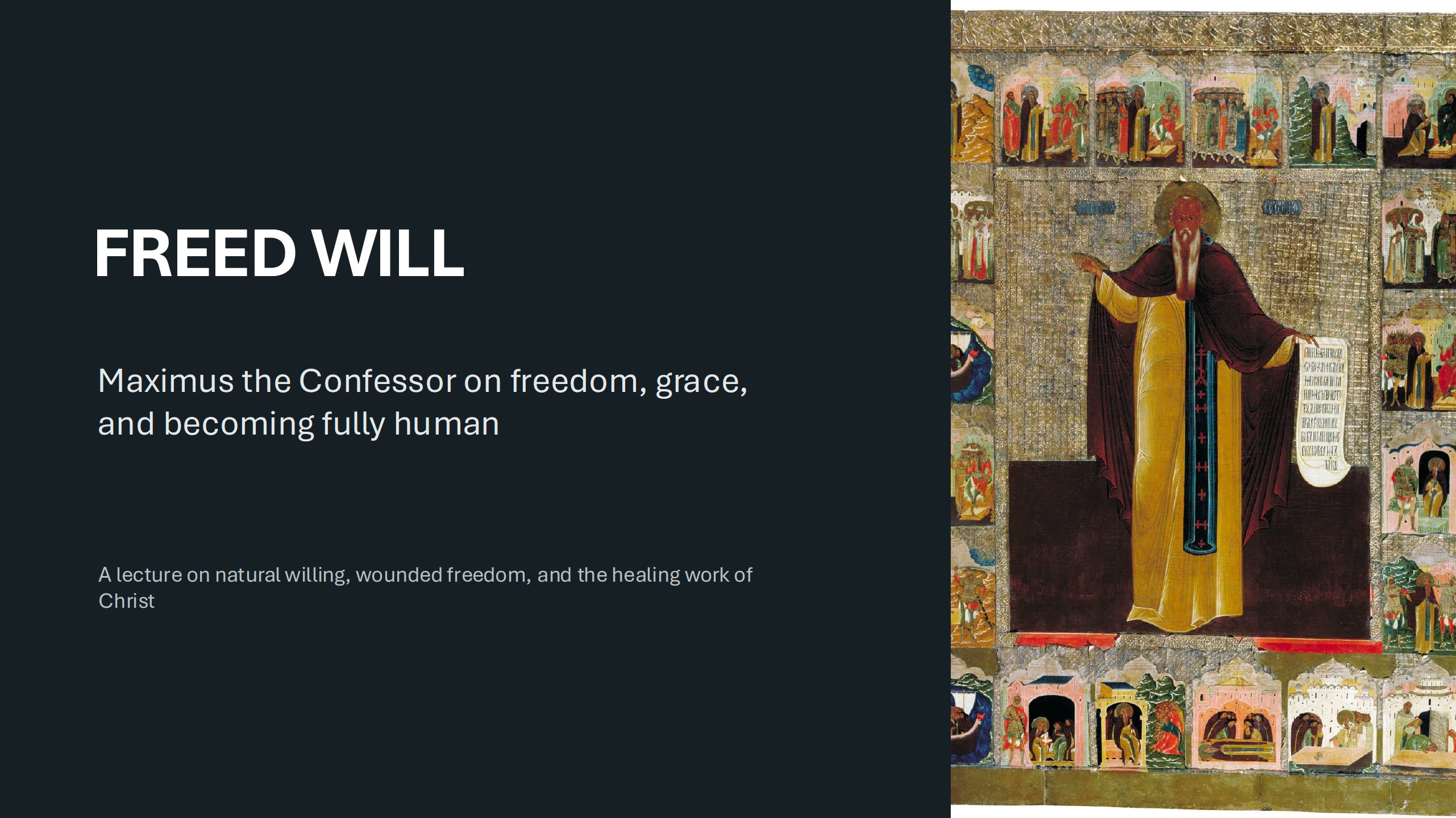
“Freed Will” - Bradley Jersak
Maximus the Confessor on Freedom Grace and Becoming Fully Human
Love Wins Conference - PPT Lecture Notes (without footnotes)
Perhaps you have seen the familiar exchange. Someone asks, “If God is all-powerful and all-loving, why doesn’t God save everyone?” The answer comes back: “Because God respects our free will.”
That answer presents a serious challenge to apokatastasis, the early Christian hope that God will finally restore all things in Christ. If someone refuses God until the day they die, what can God do? Would saving that person require God to overpower the will? Must a loving God permit the refusal to continue forever?
C. S. Lewis gave this argument its most memorable image: “The gates of hell are locked on the inside.” He meant that hell is finally self-chosen. God does not keep people out; they refuse to come in
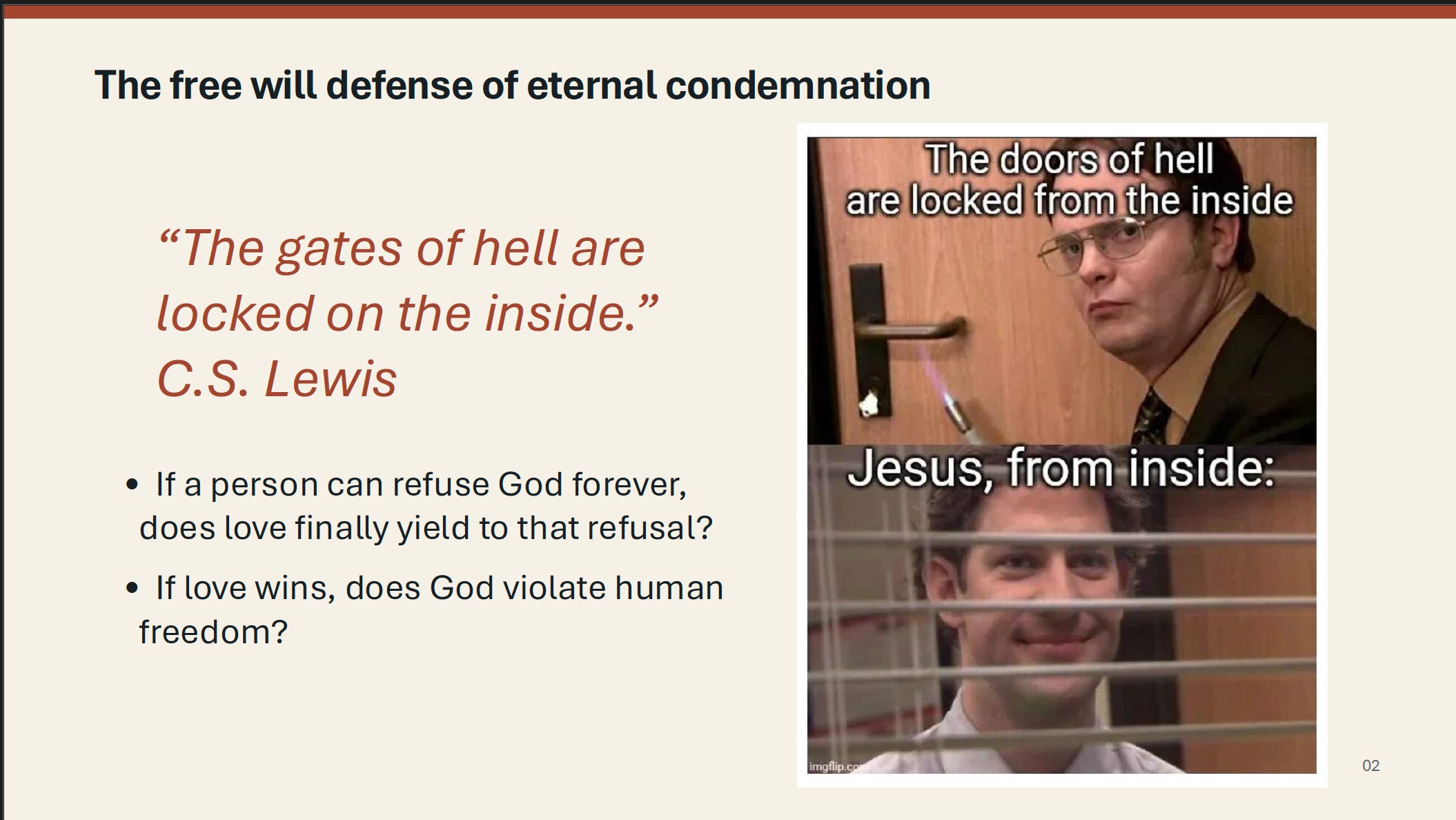
.The image has real moral force. It reminds us that love does not treat persons as objects. Even so, it assumes that we already know what a free will is and how it works. Maximus the Confessor gives us reason to look more carefully.
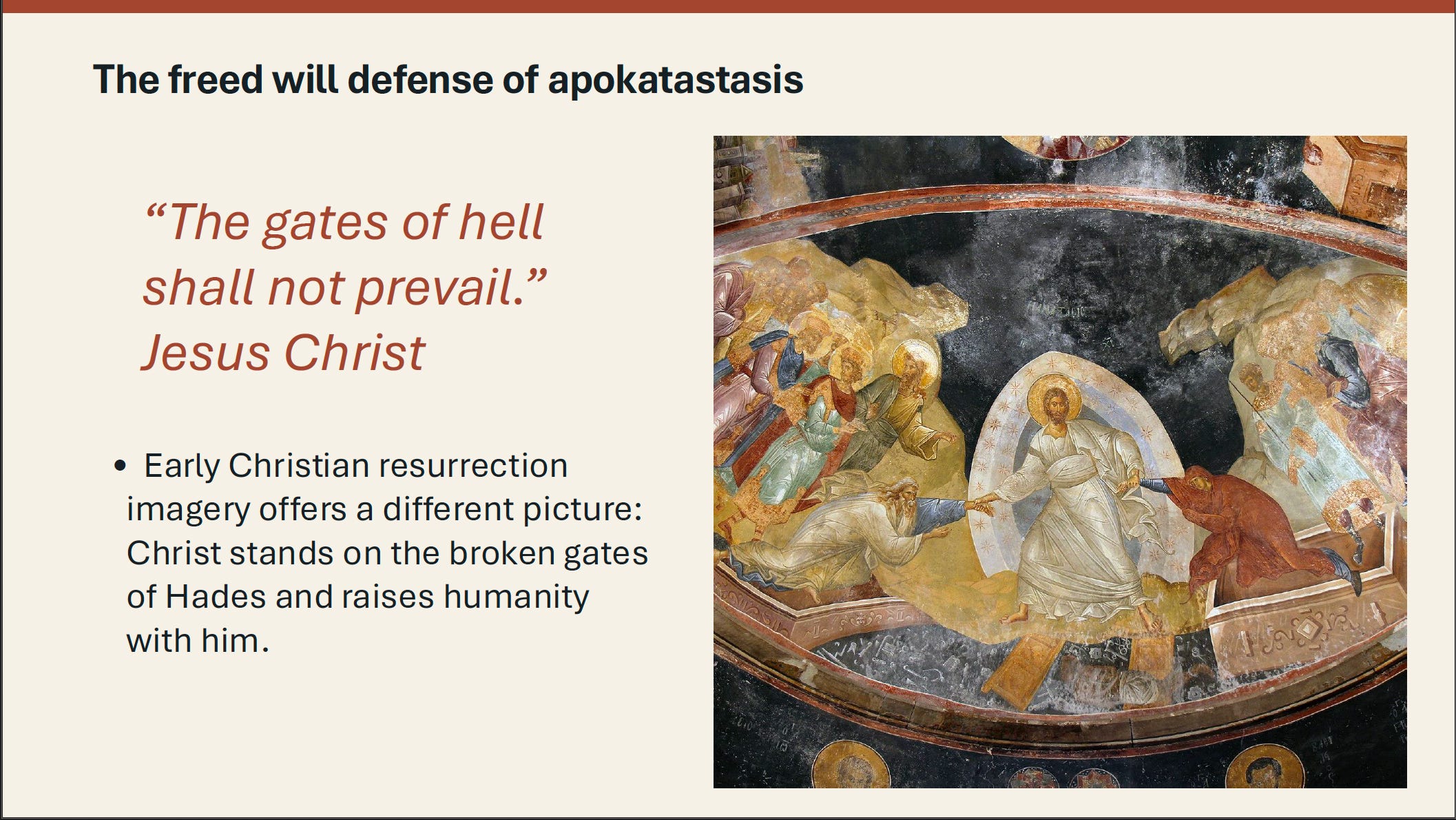
But first Christians never portrayed Christ standing outside the door of Hades, waiting for its inhabitants to unlock it. In the traditional icon of the resurrection, Christ stands on the broken gates and reaches into the grave. He takes Adam and Eve by the wrists and raises them with him.
So too the hymns of the ancient church. Two angles:
The Gates of Hades are Opened — Canon of the Cross & Resurrection
Having been tested by wounds, by Your suffering of the Cross,
You raised up with Yourself those wounded by hades.
Wherefore, I cry out: Lead up my life from corruption,
O You who loves mankind.The gates of hades opened to You in fear,
And the vessels of the enemy were plundered.
Wherefore, the women met You, receiving joy instead of grief.
The Gates of Hades are Broken — Kontakion, in Tone I
As God, You arose from the tomb in glory,
and with Yourself, raised up the world;
Human nature hymns You as God, and death has vanished,
Adam dances, O Master, and Eve, delivered from bonds, now rejoices, Crying aloud: You are He, O Christ, Who grants resurrection to all!Let us hymn as God the Almighty Who rose on the third day,
Who broke down the gates of hades,
Who raised up from the grave those held there from ages past,…Hades groans and death utters lamentation;
the world is filled with gladness, and all rejoice with it,
for You, O Christ, granted resurrection unto all.
The image does not settle the theological question, but it does suggest a different place to begin. Perhaps salvation depends less on God’s ability to persuade an untouched, self-contained will and more on Christ’s power to free a will that has become bound.
This brings us to Maximus. His account of freedom starts with a simple distinction that modern discussions often miss. The ability to choose is real, but choice and freedom are not identical.
When Choosing Is Not Freedom
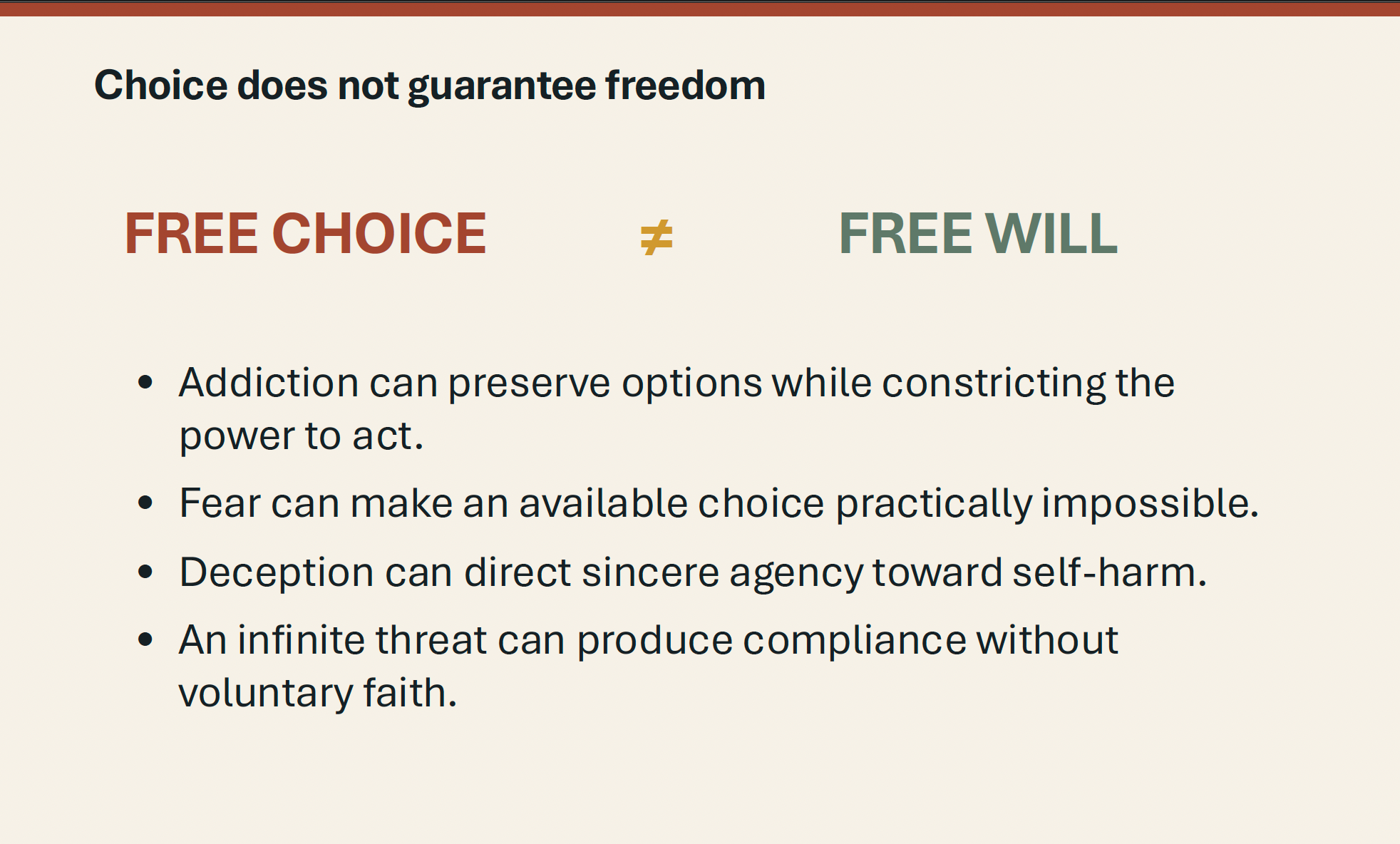
Consider a person living with an addiction. There may come a point when the person understands the harm and wants to stop, yet repeatedly returns to the same behaviour. In one sense, the person still chooses. In another, we can see that freedom has narrowed. The will operates under a form of bondage.
Fear can do something similar. A person who is terrified of flying can decide whether to board the plane, but one option may feel almost impossible. Deception complicates matters further. People can act voluntarily on the basis of propaganda or manipulation and sincerely believe that they are choosing for themselves. The decision belongs to them, but a false picture of reality has shaped it.
Religious coercion belongs in this conversation too. If a preacher says, “Accept our gospel freely or suffer forever,” the resulting confession may be a choice, but the threat makes its voluntary character difficult to judge.
These examples are different, and none of them removes personal responsibility. They do show why bare choice is an inadequate definition of freedom. A decision can arise from fear, ignorance, compulsion, or a badly distorted sense of what is good. The will is active, though it is not necessarily well.
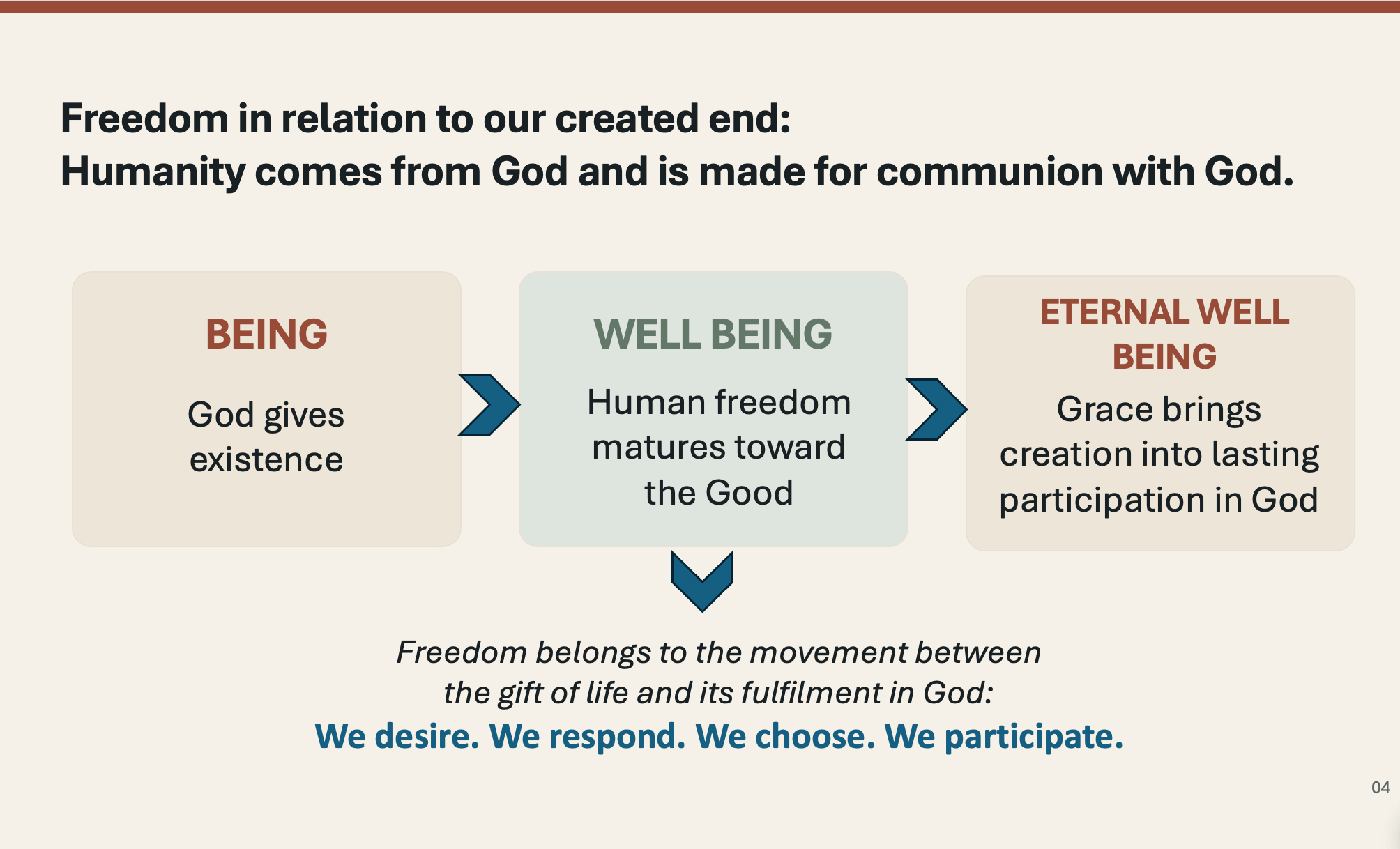
Maximus understands freedom in relation to our created end. Human beings come from God and are made for communion with God. Our natural will is the movement of human nature toward life and goodness. We do not begin as neutral creatures with an equal appetite for good and evil. We desire what appears good to us because desire itself belongs to the good creation of God.
This is easier to see in Maximus’s account of being, well-being, and eternal well-being. Being is the gift of existence. Well-being is our life developing according to its proper end. Eternal well-being is the fulfilment of creaturely life in communion with God, which Maximus calls deification. Deification does not mean that we stop being human or become God by nature. It means that grace brings human nature into full participation in the life of God.
Freedom belongs within this movement. It is not simply a possession handed to us in complete form at birth. It is our capacity to become what we were created to be.
How the Will Becomes Divided
If human nature desires the good, the fall needs some explanation. Why would a will created for God move away from God?
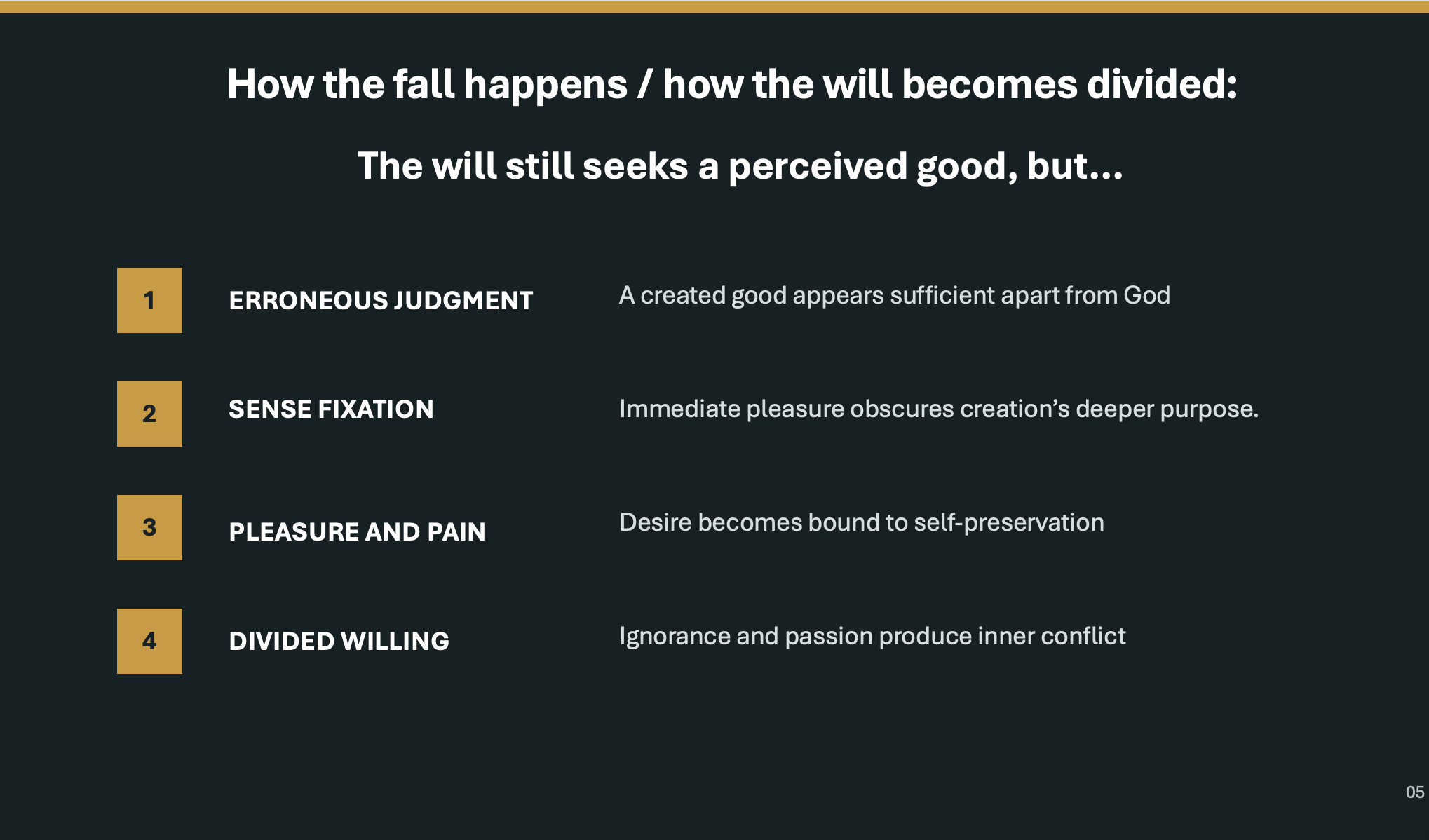
Maximus does not imagine that Adam suddenly developed an attraction to evil as evil. Evil has no independent substance for the will to desire. The fall begins instead with an erroneous judgment about the good. Maximus describes evil as the irrational movement of our natural powers toward something other than their proper goal, based on a mistaken judgment.
Adam seeks a good thing in the wrong way. In Ambiguum 10, Maximus says that Adam tried to take the things of God “without God, and before God, and not according to God.” The created world is good, and its pleasures are not illusions. The mistake lies in receiving creation as though it were a self-sufficient source of life.
That mistaken judgment leads to a fixation on immediate pleasure. The senses are natural powers; embodiment is not the problem. But when the mind no longer receives the world in relation to God, it becomes absorbed in the immediate appearance of things. Maximus says that creation contains logoi, the divine meanings and purposes of creatures held together in the Logos. A mind shaped by communion can perceive created things as gifts that lead beyond themselves. A mind governed by appetite fastens instead on whatever offers pleasure now, obscuring creation’s deeper meaning and purpose.
This fixation draws us into the cycle of pleasure and pain. Pleasure produces anxiety because the things that please us are unstable and can be lost. We begin to organize life around acquiring pleasure and avoiding pain. Maximus calls the resulting attachment philautia, a passionate self-love centred on the preservation and gratification of the self. From it grow the passions that divide the person inwardly and set people against one another.
The result is divided willing. The natural desire for the good remains, but it no longer operates clearly. We seek life in things that cannot give it. We pursue happiness through habits that diminish us. We know what would be good and still feel pulled elsewhere. Ignorance and passion now produce an inner conflict. This divided experience of willing belongs to what Maximus, in his later Christological writings, calls the gnomic mode of willing.
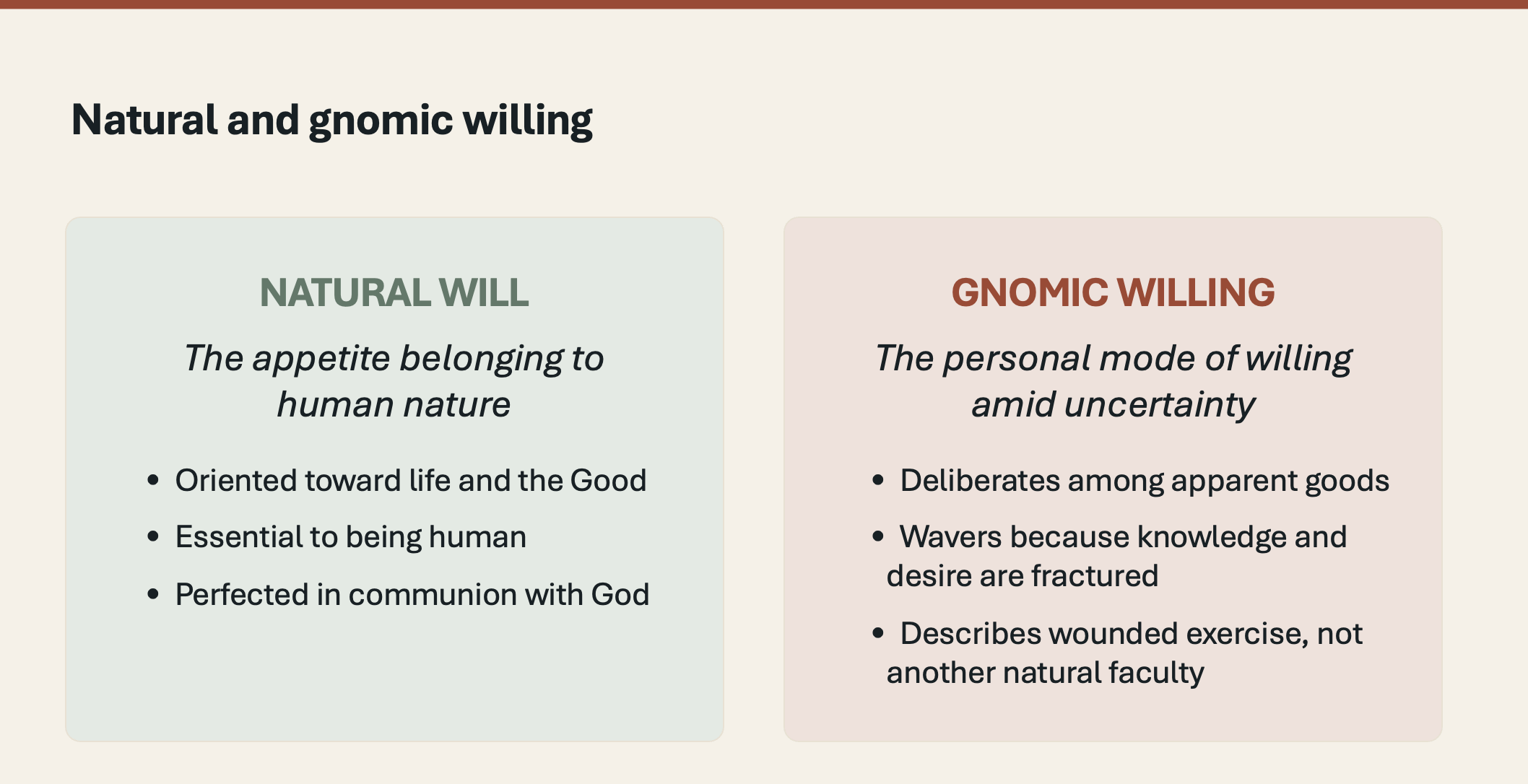
The natural will and the gnomic will should not be pictured as two faculties competing inside us. The natural will belongs to human nature itself. Gnomic willing describes the uncertain, deliberative way a person exercises the will when the good is obscured. We compare apparent goods, hesitate, change our minds, and sometimes act against our deeper desire. Nor should every instance of deliberation be called sinful. Maximus’s point is that vacillation reveals a gap between what human nature seeks and what a confused person takes to be good.
This matters for the usual free will defence of hell. If ignorance and disordered desire help produce our refusal of God, the refusal is not the highest expression of freedom. It is an expression of freedom that still needs healing. Allowing that wound to last forever would preserve the capacity to refuse, but it would also preserve the bondage from which Christ came to save us.
The Human Will of Christ
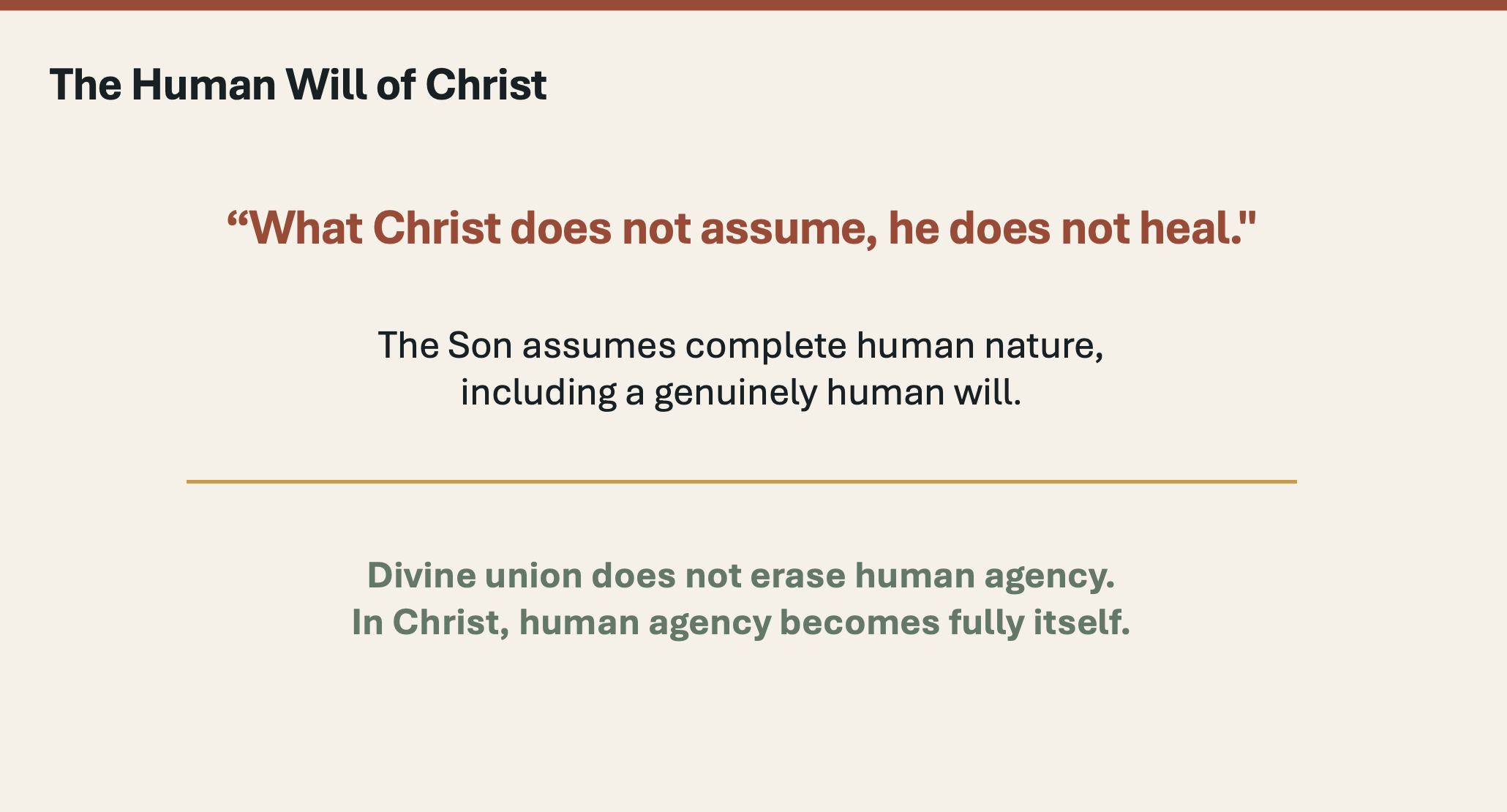
Maximus’s answer is not that God sets the human will aside. God heals it in Christ.
The Son assumes the fullness of human nature, including a genuinely human will. That point mattered enormously in the seventh-century debate over Christ. Maximus resisted the teaching that Christ had only a divine will. If willing belongs to nature, and Christ is fully human, then Christ must possess a human will as well as a divine will. Otherwise, some part of our humanity remains unassumed and unhealed.
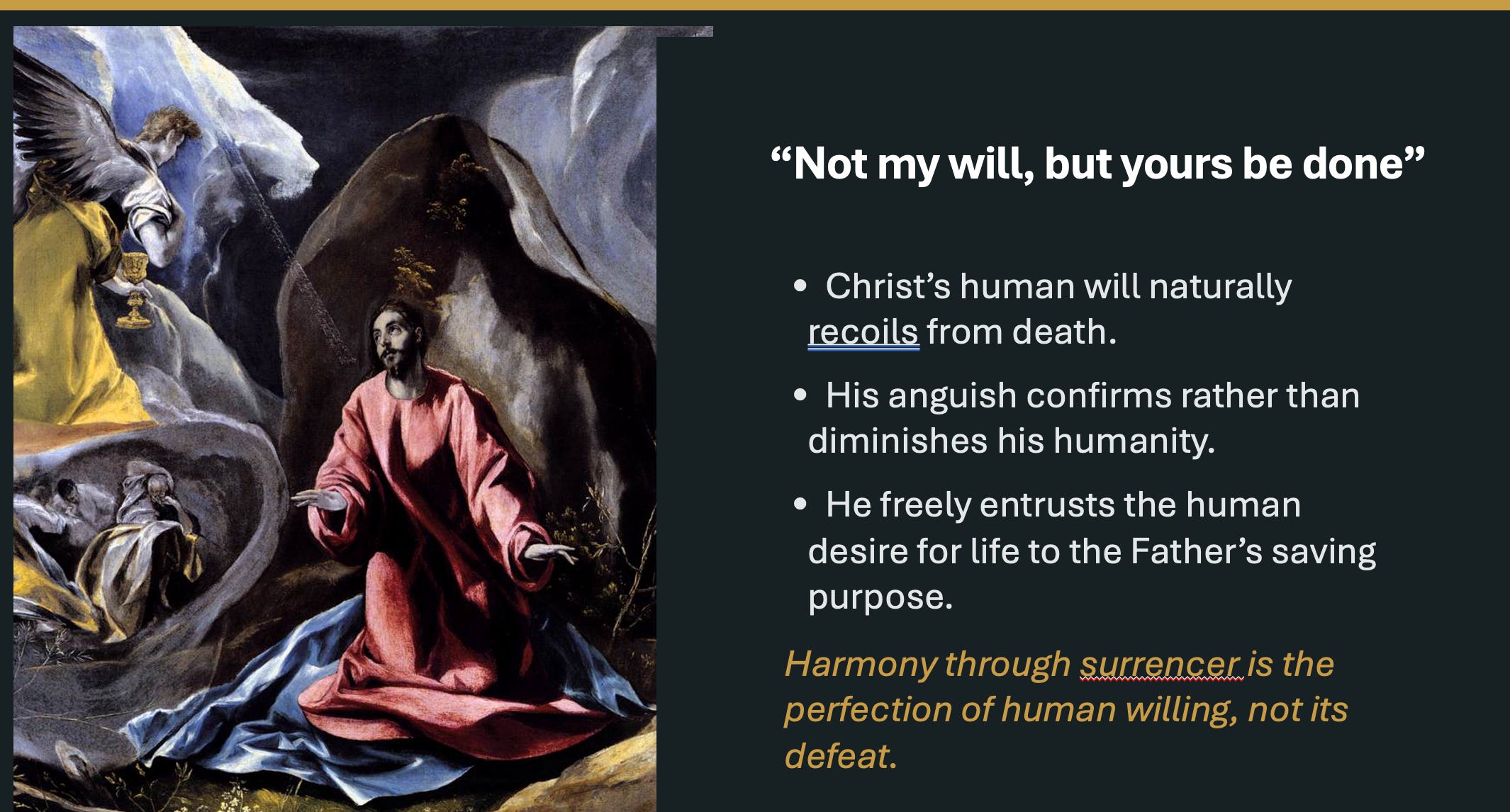
Gethsemane shows what this means. Jesus prays, “Father, if you are willing, remove this cup from me; yet, not my will but yours be done.” The prayer can sound like a struggle in which the Father’s will defeats the humanity of Jesus. Maximus hears something else.
Christ’s human desire for life is real. Death is contrary to human nature, so Jesus does not need to pretend that death is desirable. His anguish does not compromise his obedience; it confirms that his humanity is complete. Yet the natural desire to live does not trap him in self-preservation. In his human will, Christ freely entrusts himself to the saving purpose of the Father.
Gethsemane therefore reveals human freedom in its healed form. The divine will does not replace or crush the human will. Christ’s humanity becomes fully active in communion with God. His “not my will, but yours” is neither resignation nor the loss of agency. It is a genuinely human consent.
We often speak as though grace and freedom occupy opposite sides of a scale: the more God acts, the less room remains for us. Maximus does not accept that picture. Grace frees the will to act according to its nature. An injured leg is not made more authentically itself by being left untreated. Healing restores its power to move. In the same way, Christ does not honour our will by leaving its disorders untouched.
The Will at Rest in God
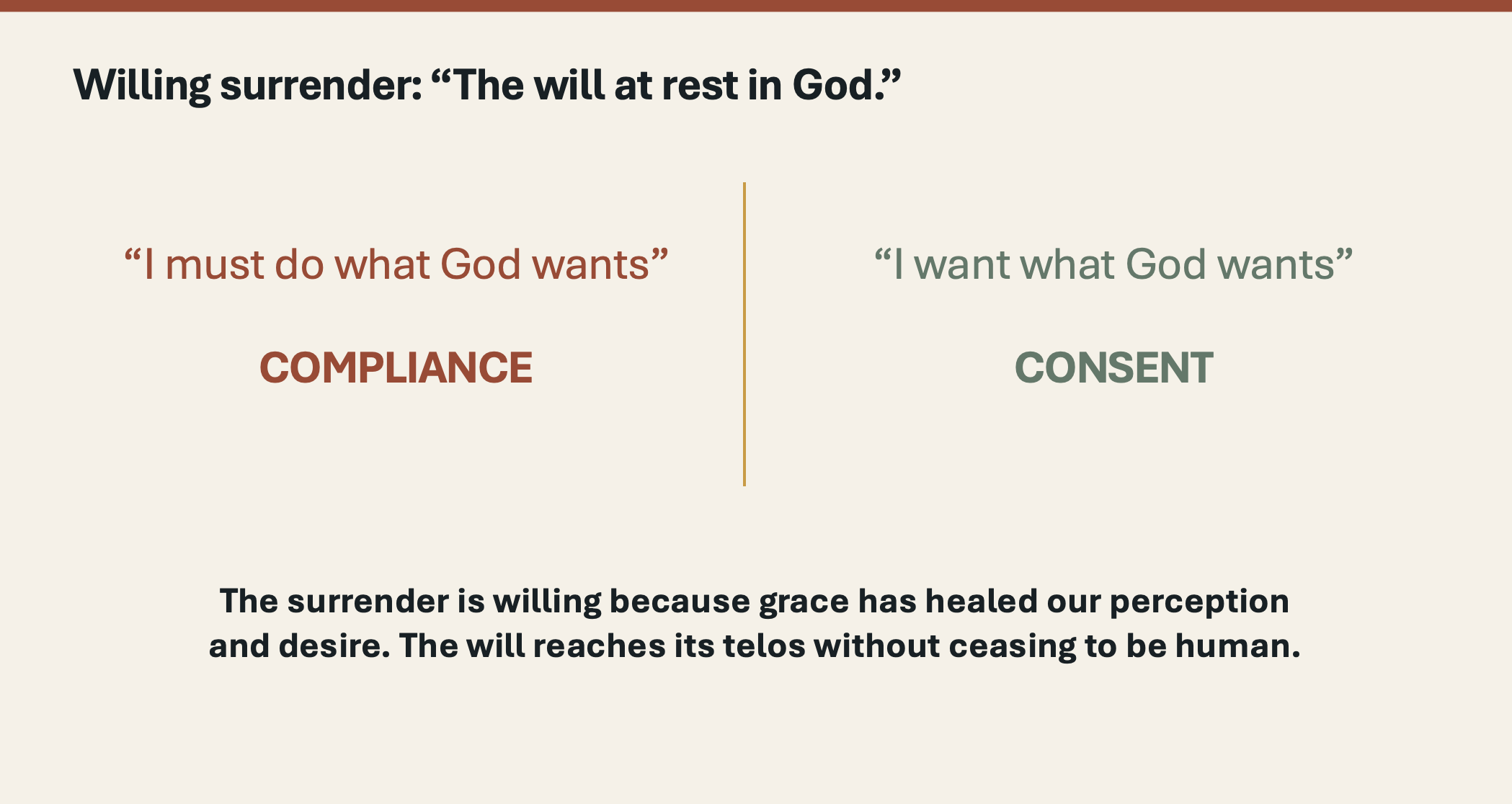
In Ambiguum 7, Maximus describes free choice finally making a “willing surrender” to God. The phrase sounds contradictory only if surrender means compulsion. Maximus has something closer to consent in mind. A person may obey because resistance carries a threat, or may come to want what is good. The outward action can look similar while the inner condition differs completely.
The lost traveller offers a useful analogy. Two paths lie ahead, one leading home and the other deeper into the forest. Ignorance makes the options appear equal, but the traveller is hardly freer for not knowing which way leads to safety. When a trustworthy guide reveals the right path, knowledge does not reduce freedom. It makes purposeful choice possible.
The same is true of our relation to the Good. We deliberate because we do not see clearly. When truth is fully revealed and desire is healed, endless vacillation no longer serves a purpose. The will can rest in God without becoming passive or mechanical. A person who loves faithfully does not prove freedom by keeping betrayal under constant consideration. Love itself has become the form of freedom.
Freedom in the Life to Come
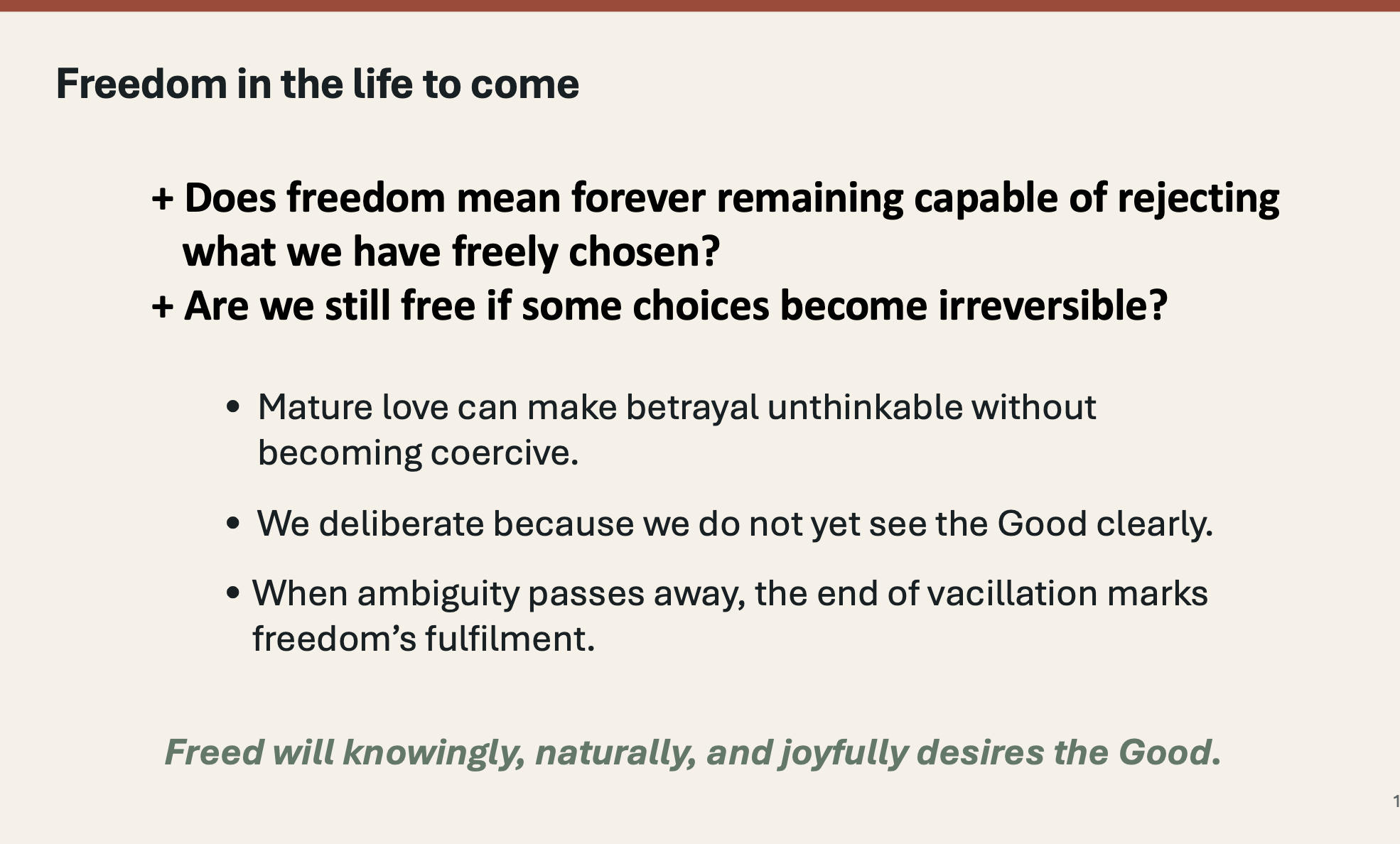
This is why Maximus can imagine a final state in which the will no longer turns away from God. The inability to desire evil is not a defect if evil was never the proper object of freedom in the first place. A healthy person is not less free because they no longer crave what destroys them.
Final Judgment and Apokatastasis
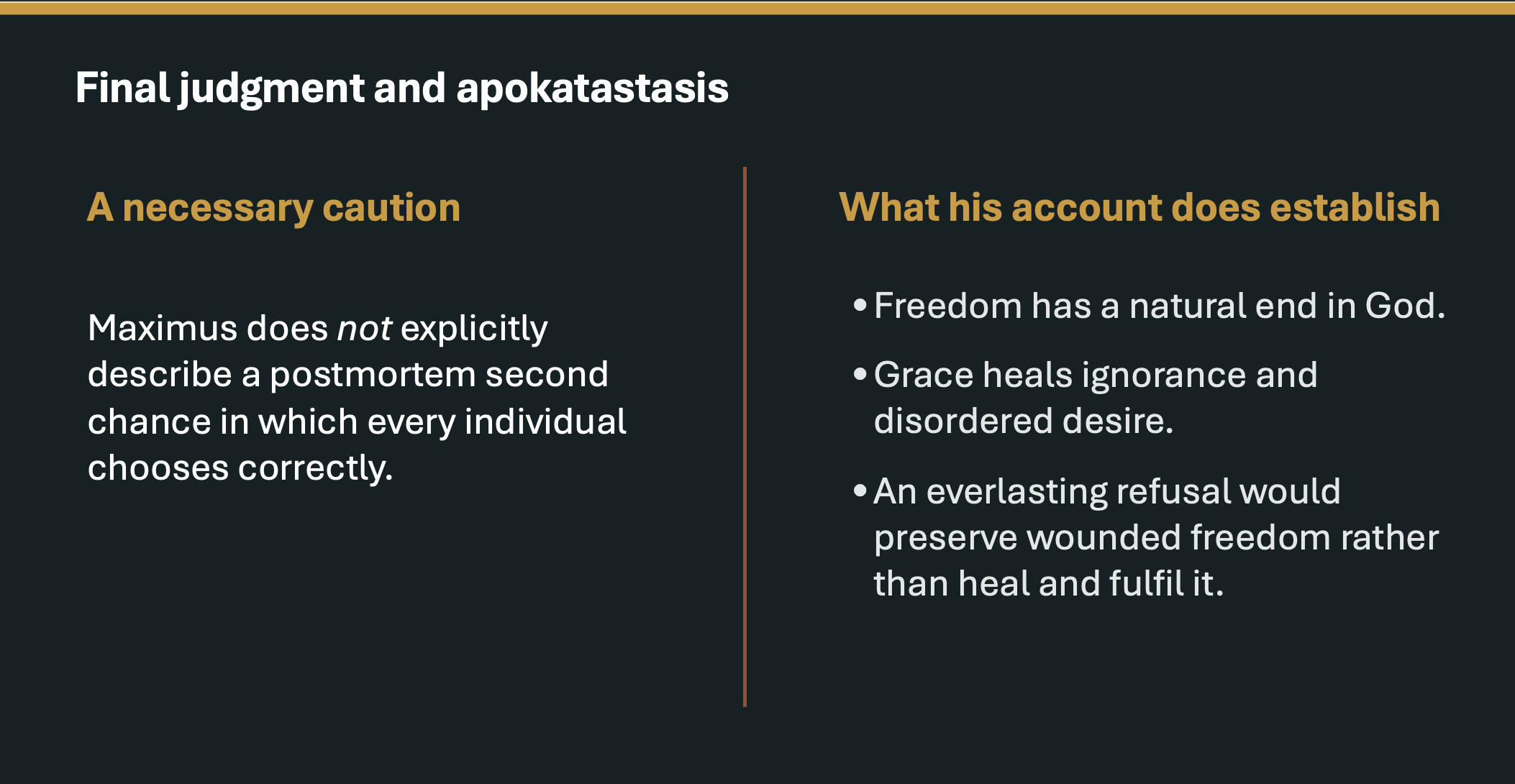
We should still be careful about how much we claim. Maximus does not give us a simple passage that says every person receives a postmortem second chance and then chooses correctly. His account of the will does not settle every historical or exegetical question about universal restoration.
What it does is change the terms of the argument. If grace removes ignorance, heals disordered desire, and brings the natural will to its proper end, then salvation does not culminate in God overcoming human freedom. It culminates in human freedom becoming whole.
Freed Will
The question is no longer whether God can force a final yes. The question is whether Christ can heal the will all the way down. Maximus gives us good reason to hope that grace does not stop at the locked door. It reaches the person who locked it.
We are not saved by becoming less human or less capable of willing. We are freed to become what God created human beings to be. This is more than free will in the ordinary sense. It is freed will.
What happens to Lewis’s locked door
Lewis’s image works if freedom means the permanent ability to say no. Maximus presses us to ask what lies behind the refusal. If ignorance, fear, addiction, and disordered desire can distort the will, then a person who continues to say no may be expressing wounded freedom rather than perfected freedom.
The door may indeed be locked from the inside, but the inside is precisely where God’s healing must reach. The hope is not that God eventually kicks down the door and drags the person into the kingdom. It is that grace heals the person who is hiding behind it until the door can be opened willingly. God does not defeat the will. God makes it free enough to recognize home.
Does this ‘prove’ apokatastasis
It does not prove that Maximus taught a postmortem second chance, because the texts considered here do not say that. But as I read him, Maximus’ account does make an eternally fixed refusal impossible to identify with freedom. If God heals the will, removes confusion, reveals the Good, and brings human nature to its fulfilment, the movement of salvation points toward restored participation in God rather than a creation divided forever.
Will God’s healing of the will finally succeeds?
Maximus absolutely follows Paul and Gregory to their natural conclusion: “God shall be all in all.” Thus, ultimate redemption through the healed will rather than coercion.
Apokatastasis begins to look less like an exception imposed on Maximus’s theology and more like the direction in which a freed will finds its telos. He has convinced me, at any rate, the healing work of Christ finally succeeds.
Last word goes Maximus from Ambiguum 7:
“God himself [will] be all in all, encompassing all things, and making them subsist in himself.”
Yes! For those that may appreciate further study on the topic: https://afkimel.wordpress.com/2016/08/30/the-problem-of-hell-and-free-will/
This article from Bishop Green on Eclectic Orthodoxy was a helpful aid in my growing understanding of the human will and its relation to and generation from the Good. (Still is.)
Thanks Bradley this is very well formulated! I've been pondering the same topic for a while and I believe I'm reaching similar conclusions.
I start from what Paul says as the basis of reality: "in him we live, and move, and have our being" - we are not self-existent lives, we live in God, all of us receive our existence as gift from the eternal Father through Christ in every moment, but sin is blindness to this reality and our attempt to live as if it was not true. All our problems can be traced from here and followed how they lead up to the cross. If Christ judged the world and its ruler there and expelled it, then it shows what our belief in separation causes, we try to separate ourselves from the one in whom we exists, but the resurrection reveals the contradiction and refutes it.
Then judgement can be understood as Christ's refusal to let the lie remain and the truth of reality encountering everything that the blindness has built. The idea of "free will" is then our ontological idolization of "separate existence". We have never existed apart from God, and our true freedom lies in the restoration of our sight to this reality until we became capable of resting in the ground of our being naturally. It very well fits with how you described Jesus' human will entering its rightful place in submission to the Father.
It's such a profoundly different account of reality, theology and even our relationships; that I'm still struggling to fully process all its implications, but it's very helpful to see how others are processing God's full revelation today, and how others have been doing this before us! As far back as Maximus and the Apostles, even Old Testament authors!
Thanks for the excellent work again!