

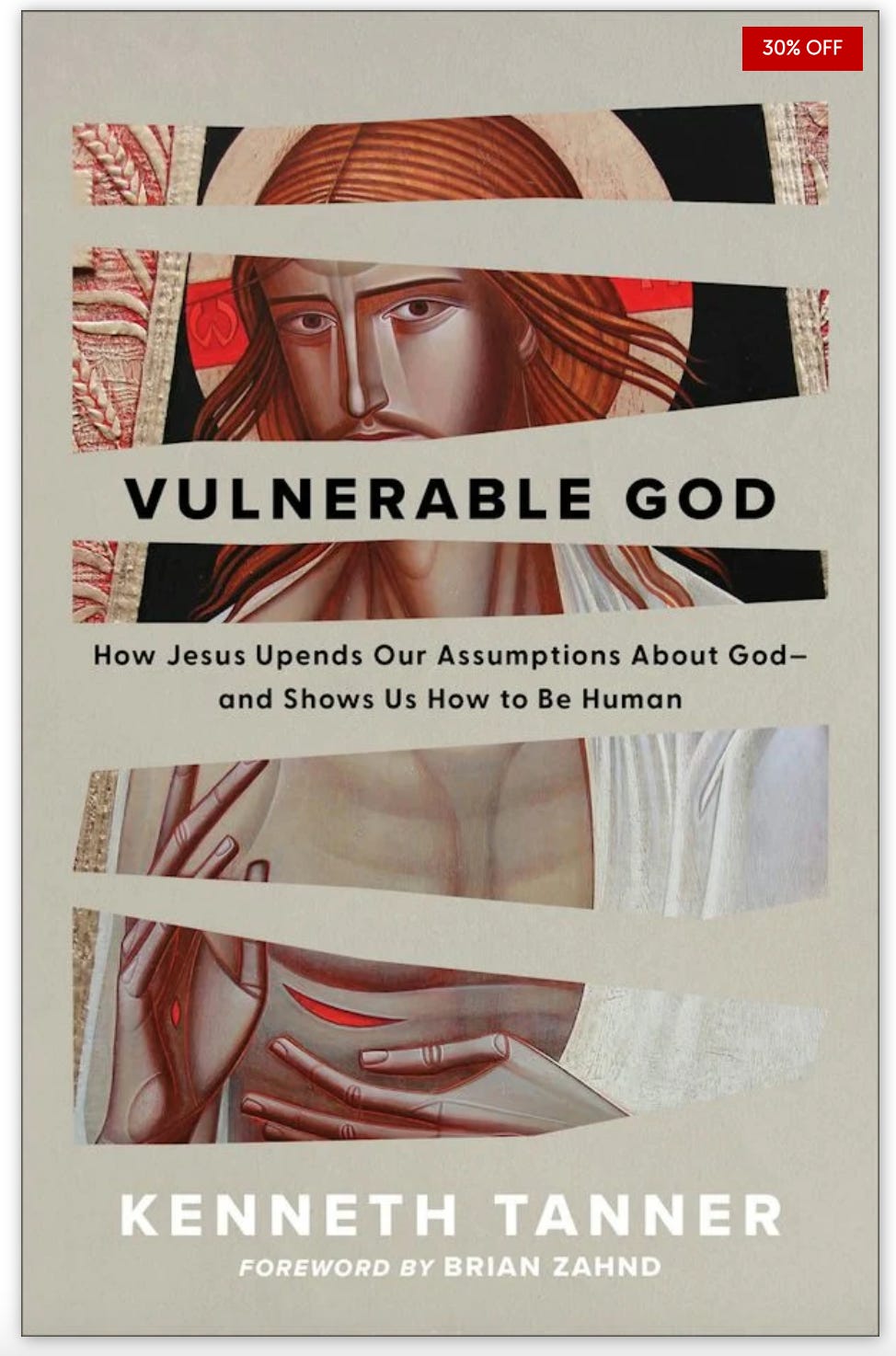
Fr. Kenneth Tanner, Vulnerable God: How Jesus Upends Our Assumptions About God — and Shows Us How to Be Human (Brazos Press, 2026).
New release: If you purchase on Baker Book’s site, it’s on sale for $13.30 $18.99 (30% Discount plus Free Shipping).
Wringing My Hands
I have been wringing my hands for weeks over Kenneth Tanner’s worth-the-wait debut book, Vulnerable God. I worry that all the lovely things I want to say will be easily dismissed since Fr. K is a friend and co-labourer. More than that, he is my beloved brother, a mutual confessor, an Open Table Conference team-teacher, with whom I am in daily contact. We’ve walked miles together over mountains of hilarity and through just as many deep valleys.
I’ve also been one of his interlocutors through the writing of this book. At times, I’ve kicked his butt on deadlines and shared strong opinions he took seriously. I admit it: my review may be tainted by affection, but I genuinely believe this book is a masterpiece that should be in print a century from now.
Further, I am intimidated by the calibre of other reviews that flood my newsfeed. Credible people of greater standing and influence have composed reflections with striking literary flourish. What can I say that they haven’t written more beautifully and with greater gravitas? I won’t compete with Malcolm Guite, Fleming Rutledge, and Brian Zahnd. Sorry, my imposter’s syndrome is showing.
In this review, I won’t bother summarizing Vulnerable God. You can find the essential details in the back cover copy in retail sites. I will, however, reproduce my endorsement to say what I really think:
The Jesus you will meet in these pages is the human God, whose cruciform love is the face of God to a world in crisis. This Jesus is the living revelation that not one more person needs to die for the world to be put right.
Principal, St. Stephen’s University
Author, A More Christlike trilogy
Upon reflection, my endorsement truly is a synopsis, not only of Tanner’s book, but also of his life message. In fact, he’s been preaching and publishing these very themes for decades (and in Clarion-Journal.com articles since 2015).
So, what is left to say?
Buy the book. There.
But also…
Kenneth Tanner is a Pastoral Christologist
Kenneth is described as a pastor and theologian, but I can be more specific. First, he is a priest “for the life of the world”—the person who police call first to sit with parents in the hours after a school shooting. The one you call when your loved one is missing and presumed dead. As a priest, he wears the collar to say, “I’m here for you as God is here for you.” Father K opens with a story that illustrates the human and humanizing why of his theology.
And while he is certainly a theologian, Fr. Kenneth is more specifically a Christologist in the patristic tradition. Through many years of research and meditation, Kenneth unveils what it means for Christ to be the Word of God, the Image of God, the Image of humanity, and the crucified and risen revelation of “the human God”—a provocative phrase to be sure. And central to Kenneth’s Christology is his trademark phrase, “Becoming Human as God is Human.” That vision is his distinctive fingerprint—the defining theme of his personal, pastoral, and theological legacy.
As for Tanner’s Christology, his dogmatic (in the literal sense) convictions are thoroughly Johannine, yet (or therefore?) often prompt double-takes and deeper conversations—including rigorous in-house debates that I find intriguing and generative. I’ll offer just a few key examples that I want to engage with my own perspectives:
1. Kenneth believes Jesus is the Christ
He resists any bifurcation of Jesus and the Christ. He rejects any notion that Jesus of Nazareth is just one human instance of the Christ, or a brief human episode of the eternal Word. So, no, he insists, you and I are not Christs in the same way Jesus is the Christ.
We are, however, being transformed by grace from glory to glory into the image of Jesus Christ, and into what he alone is by nature (see 2 Corinthians 3).
Thus, Kenneth follows Fr. John Behr’s formula that “through his Passion, Jesus Christ, as man, becomes that which he, as God, always is.” In other words, the one person we know as Jesus Christ—incarnate, crucified, risen, and ascended—is the same eternal Son in whose image “Adam” [humanity, male and female] was created. That same vulnerable human being, Jesus of Nazareth, also says, “Before Abraham was, I am.” Otherwise, Behr warns, you end up with two distinct prosopons.
Behr does distinguish between the New Testament’s uses of “Jesus” and “Christ,” especially in Paul, but both refer to the one divine-human person. Kenneth would agree, but he is likewise alert to the ways that distinction can slip into a separation of Christ’s divinity and humanity (cf. Nestorianism).
That’s a bit nerdy and complex but, well, read the book. Kenneth makes it accessible.
2. Kenneth believes Jesus is God
Kenneth is unapologetic about his patristic and creedal confession of the full deity of Jesus Christ. To be “Christian” in his view is to see Jesus Christ as the face of God, “of one essence with the Father.” Or to paraphrase Jesus, “If you’ve seen me, you’ve seen the Father.” Not that Jesus IS the Father but that “I am in the Father and the Father is in me.” The ancient church asserts that this union with God is true of Jesus by nature and is becoming true of his followers by grace, as the firstfruits of human destiny.
It may seem obvious to my Jesus-following Muslim brothers and sisters that Christians such as Kenneth must confess the full deity of Christ, while Muslims must reject that confession out of faithfulness to their own tradition. To be “Christian” is to make this confession by default. But this assumption requires some clarification. These nuances are my thoughts—don’t blame Kenneth:
Clarification 1 - First, it is not the case that confessing the doctrine of Jesus’ full deity is what “saves us.” The Christian gospel says we are saved by the grace of God through the faithfulness of Christ, not by assent to correct doctrines.
For Jesus, doctrinal claims mean little apart from discipleship. Our primary response to the love and mercy of God is to love God and neighbour. Following Paul: if I understand all mysteries and possess all knowledge but have no love—well, forget about it.
Clarification 2 - Not all Christians whose doctrines seem sound faithfully follow Jesus and his call to his Way of love. That’s a great tragedy spanning church history. And it’s the grace of God that Christ is faithful even when we are not.
Clarification 3 - Many who identify as “Christian” have not and do not believe in the full deity of Jesus Christ.
According to John Behr, up until the Council of Nicaea in the early fourth century, “subordinationism” was a common theological position. Many took Jesus’ statement, “The Father is greater than I” (John 14:28) to mean that he was less divine than the Father. Cyril Hovorun, a Ukrainian Orthodox monk and scholar, estimates that up to 85% of the bishops who attended the First Council were Arians. Arius taught that the Father brought the Son into existence before the ages, and that the Son did not eternally shared the Father’s divinity. Yet we would not deny these folks were Christians.
Likewise, in a recent State of Theology survey, American Evangelical respondents were asked whether they agreed with the statement, “Jesus was a great teacher, but he was NOT God.” I was surprised to see that 49% either strongly or somewhat agreed and another 11% weren’t sure. Technically, then, half of American Evangelicals are theological heretics. Does that mean they aren’t Christians? I don’t think so.
This is not to say belief in the deity of Christ doesn’t matter—I think it does—but it should not be assumed that the label “Christian” guarantees either faithful discipleship or belief in Christianity’s historic creeds.
Clarification 4 - Conversely, I know that despite our differences on that doctrine, many who do not identify as Christian at all do faithfully follow Jesus. Many friends of other faiths or no faith consciously live by the Sermon on the Mount and exhibit Christ’s liberating transformation in their real lives. So given the diversity of belief among Christians themselves, it is disingenuous to condemn Muslims, for example, for honouring Jesus as God’s prophet and Messiah but not seeing him as fully divine.
Clarification 5 - Does is matter? If doctrinal conformity is not essential to our salvation or entry into the kingdom of God, does the confession of Christ’s deity in the New Testament, the historic creeds, and in Vulnerable God really matter?
If doctrinal conformity is not essential to our salvation or entry into the kingdom of the heavens, does the confession of Christ’s deity in the New Testament, the historic creeds, and in Vulnerable God really matter?
Yes, I believe it does. But why?
Well, read Kenneth’s book. But I’ll offer one quick and inadequate response: I believe the fullness of the Creator’s union with creation—the communion between transcendent Reality and frail humanity—is established, revealed, and communicated through the union of theos and anthropos in one person.
I believe the fullness of the Creator’s union with creation—the communion between transcendent Reality and frail humanity—is established, revealed, and communicated through the union of theos and anthropos in one person ... I am united to God in the fullness of my humanity, frailty and all.
That matters to me, but not because I think my soul depends on theological precision. It matters to me because it means that in Christ, I am united to God in the fullness of my humanity, frailty and all.
3. Kenneth believes God is human.
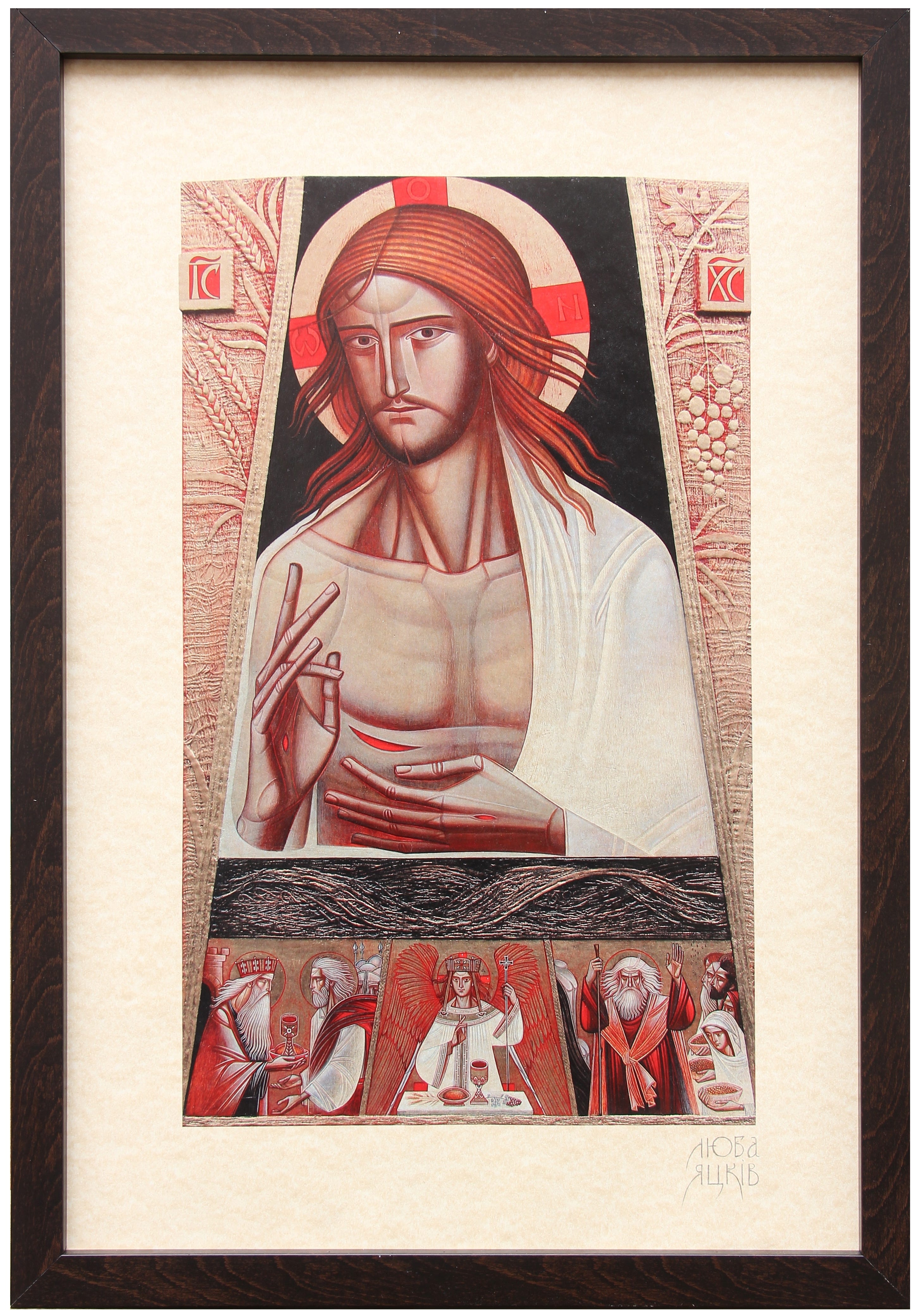
This is Vulnerable God’s most daring claim. While the statement, carefully defined, lies within the bounds of Christian orthodoxy, Kenneth’s way of saying it can sound jolting. Understood in one sense, the statement would be misleading. After all, Jesus says that “God is spirit” (John 4:24), and Scripture maintains a clear distinction between Creator and creation.
But there’s also a way to say it that seems true to me, even as a minority report in Christian theology. As I understand Kenneth, he confesses the eternal humanity of Christ, who is also eternal God. And at the same time, the One on the Cross we call God is, in the fulness of the human condition, also as vulnerable as you and me. It may make your head spin, but here is one way to understand it:
If Jesus Christ is one undivided person, fully human and fully divine, then the humanity we encounter in him belongs to the eternal Son himself.
In just that sense, we can speak of God as human.
I think that’s what Kenneth means, but I’ll ask you to test my account with his actual words. And beautiful words they are.
Kenneth Tanner is a Wordsmith
Finally, I’ve carefully scanned Vulnerable God for a few samples that show off Kenneth’s tender heart and poetic wordsmithing, particularly those highlighting the fullness of Jesus’ humanity.
When in the synagogue we see Jesus, we see the Father, breathing eternal wisdom through Jesus’s sun-parched lips by the Spirit. (60)
This God thirsts not only for water, but also for union with us and with all creation. (77)
If we cannot imagine the divine and human person we encounter in the scriptures doing or saying something that brings harm, even unintentionally, to anyone or anything, then we cannot and should not imagine God doing that harm. (92)
We will all die, and many more will be slain because we forget who we are, but Christians—as people who believe that the death of Christ is the only death that can make the world right again, who trust that when as a human God dies for the world he loves, that death itself dies—ought to be the people who say to the spirit of Cain in all the ways that spirit arises in us, “No more!” (152)
Every human—each of us a mixture of the oppressor and the oppressed—stands under the inexplicable hardwood pardon of the cross. (154)
When we encounter Jesus Christ, we don’t live to tell about it. We die with him, showing that by the weakness of his cross (and ours) joy has entered the world. There is nothing more life-giving or converting or transfiguring than to at long last fall into the arms of God crucified and buried. (166)
And there you have it.
I recommend Vulnerable God without caveat, and I would suggest that if you attend a Christian fellowship of some sort, consider purchasing it as a gift for your pastor, priest or teacher.
Thank you, Kenneth.
On Jesus as God in John 1, John 20, and the early Church (before and after Nicaea) per DBH.
See https://youtu.be/EWkdxNKvgi8?si=M5J1xkOnTvrllecj
What a beautiful, thorough and truthful review. I agree with you that this book should still be in print 100 years from now. I've already gifted it to my pastor, who is already a fan of Fr Kenneth, and it is already proving hard for him to hold off devouring the book before the plane ride tomorrow that he's saving it for! Can't say I blame him. The book is already a treasure.