

Question:
In light of Christ’s revelation of God’s saving grace, how are we to understand his statement, “Be perfect as your Father in heaven is perfect”? (Matthew 5:48)
The “Perfect Man”
Was there ever a “perfect man”—fully sanctified and completely sinless?
Bp. Chris E.W. Green told me a story (I hope I get it write) about a Holiness Pentecostal Church where “complete sanctification” in this life was the dream of every member. He described the annual New Year’s Eve service where people would confess their sins publicly… but one man, sitting aloof in his own bring-you-own lawn-chair would announce, “I went the whole year without sinnin’… again.”
This occurred year after year until one day, he proclaimed, “I went the whole year without sinnin’… again… But the Lord tol’ me if I stayed here, I would.” Then he stood, folded up his lawn-chair, and left. For good.
I may not have this tale just right, but why ruin a good story with the facts.
Deluded Perfectionism or Exhausted Failure
Imagine trying to be the perfect human! Imagine striving to be perfect like Jesus was perfect! Imagine trying to be as perfect as God himself! If we were to take Jesus literally there, we’d either be deluded in our perfectionism or exhausted failures all the time. It’s just not possible and even seems completely pointless.
Religious or moral perfectionism makes for a fragile faithfulness … fraught with peril and freighted with crushing burdens. The self-righteous are forever just one slip from moral catastrophe and spiritual despondency, or so you’d think. I call this “spiritual constipation.” Surely, there’s a laxative for that!
Grace as a Loophole
For this reason, some of the great Reformers such as Martin Luther preached that the impossibility of perfect obedience was the whole point of Jesus’ Sermon on the Mount. He theorized that the impossibly high standards of righteousness would lead us to despair and convince us to cast ourselves on grace. This reading became a loophole that would allow us to not follow Jesus—if by follow we mean obey (which became a swearword for many in the grace movement). Worse, some preachers even asserted that Jesus’ teachings were “old covenant” and that endeavouring to obey them denied the gospel!
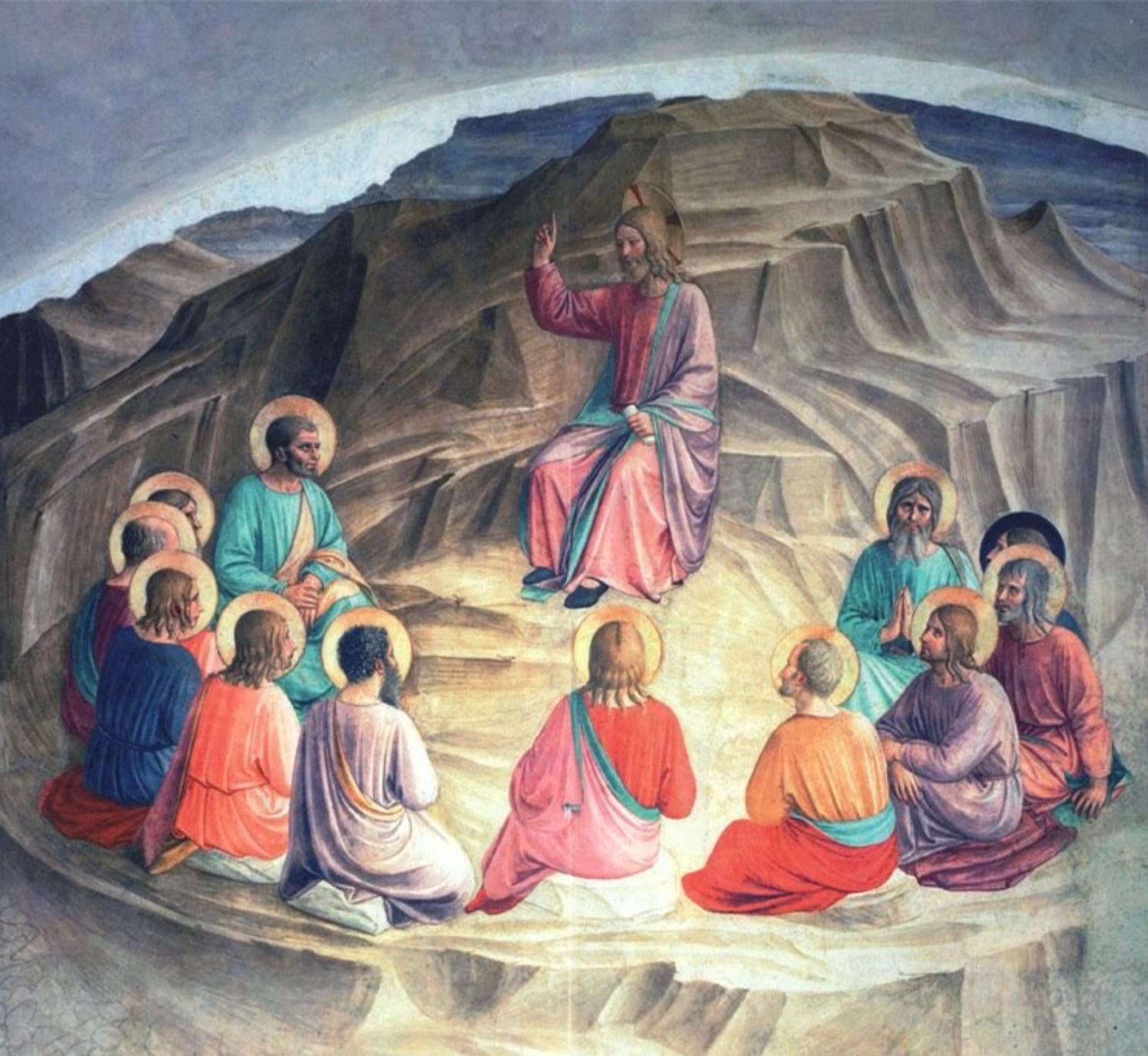
I’m not so sure. Consider the end of Jesus’ message, where he insists that the wise person who builds their house on the rock hears Jesus’ words and puts them into practice. As James says in his letter (a beautiful commentary on Jesus’ teaching), “be doers of the word and not hearers only.” So, I’d rather not simply ride the pendulum from perfectionism all the way to finding the loopholes to ignoring Jesus.
“Be Perfect” = Telos, fulfillment, completion, maturity
How then shall we hear the words, “Be perfect.” It seems that this translation creates confusion because the word for perfect there is derived from the Greek telos … usually translated as “end” as in fulfillment, completion or maturity. The telos of an acorn is an oak tree. The telos of a lamb is a sheep. And the telos of mature humanity is to reflect the image of God, revealed in Christ as self-giving love, grace and mercy, generosity and hospitality. In other words, Jesus is challenging his disciples to “grow up” as children who imitate their Father’s graciousness.
This becomes more obvious in context … here’s the passage in The Message Bible:
“You’re familiar with the old written law, ‘Love your friend,’ and its unwritten companion, ‘Hate your enemy.’ I’m challenging that. I’m telling you to love your enemies. Let them bring out the best in you, not the worst. When someone gives you a hard time, respond with the energies of prayer, for then you are working out of your true selves, your God-created selves.
“This is what God does. He gives his best—the sun to warm and the rain to nourish—to everyone, regardless: the good and bad, the nice and nasty. If all you do is love the lovable, do you expect a bonus? Anybody can do that. If you simply say hello to those who greet you, do you expect a medal? Any run-of-the-mill sinner does that.
“In a word, what I’m saying is, Grow up. You’re kingdom subjects. Now live like it. Live out your God-created identity. Live generously and graciously toward others, the way God lives toward you.” Matthew 5:43-48 (The Message)
Growing in Generous Grace via Inner Transformation
So our telos does not look like moralistic perfection or puritanical judgments. Growing by grace into our telos looks exactly like the generous grace of our heavenly Father, achieved not through striving to look right or be right, but through surrender to the transforming grace of God’s indwelling Spirit. The more we receive the Light of God’s generous grace, the more our lives will refract that Light into the world as God’s indiscriminate kindness.
In the end, our takeaway is that the telos Jesus calls for is Spirit-empowered, Abba-like grace, not a hopeless and self-defeating perfectionism. Jesus assures his followers that growing into that life of grace comes as we follow him on the Jesus Way.
"Perfect" in the Sermon on the Mount (Matt 5:48) becomes "merciful" in the Sermon on the Plain (Lk 6:36).
Something I have been pondering...Matt 5:48 compared to Luke 6:36. It seems as if the idea of perfection from a Jewish POV was more about loving God wholeheartedly, with our whole heart, strength, and mind. That seems to be the idea of perfection. Compare that with Luke 6:36, where Luke uses the words mercy and merciful instead of perfect. Is it possible that perfection and merciful are synonyms in this context?