

Andre Agassi
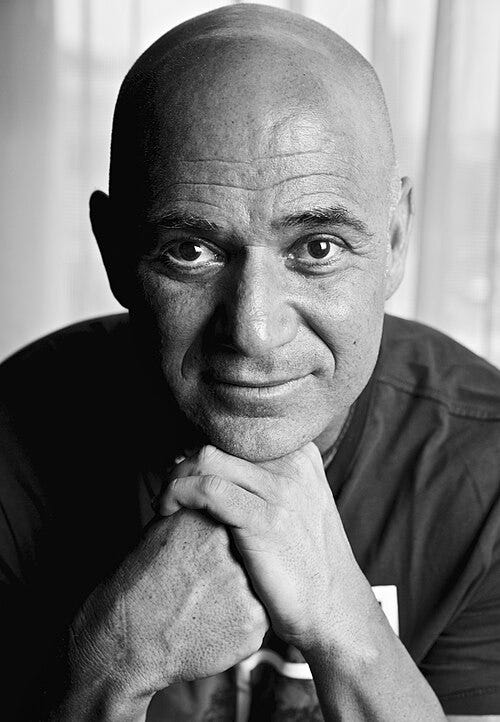
Andre Agassi is known primarily as one of history’s greatest tennis players, and one of only five players (male or female) to win the “Golden Slam”—i.e., winning all four grand slam tournaments and an Olympic gold medal. (His wife, Stefanie Graf, is the only player to accomplish that feat in one calendar year). With 8 Grand Slam singles titles and 60 ATP titles, he was ranked world No. 1 for 101 weeks.
Twenty years after his retirement, Agassi continues as a generous serious steward of the gifts he’s been given, particularly through the Agassi Foundation for Education, raising over $190 million to provide educational opportunities and resources to otherwise underserved populations.
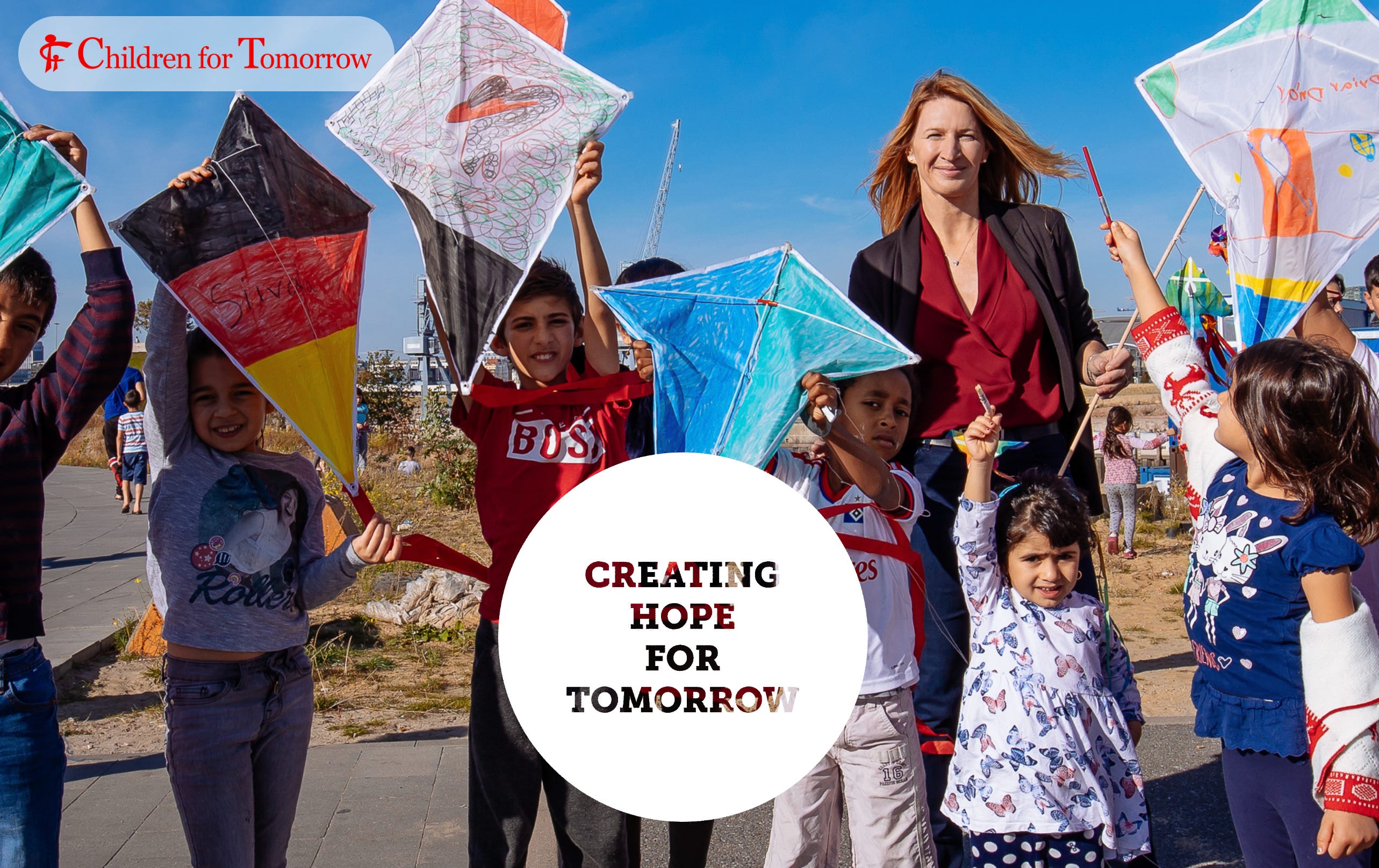
Meanwhile, Stefani’s foundation, Children for Tomorrow, focuses on helping children heal from psychological wounds of war through trauma-informed therapy among refugee/immigrant populations from war-torn areas.
These are the type of helpers I watch for and whose work I trust. They transcend ideologies and bypass polarization to focus on peace-building ways that create hope and healing. So as a fan, yes, I’m a fan. If you have some stray giving that needs a place to land, I’m sure they’d welcome your help.
Coach Agassi
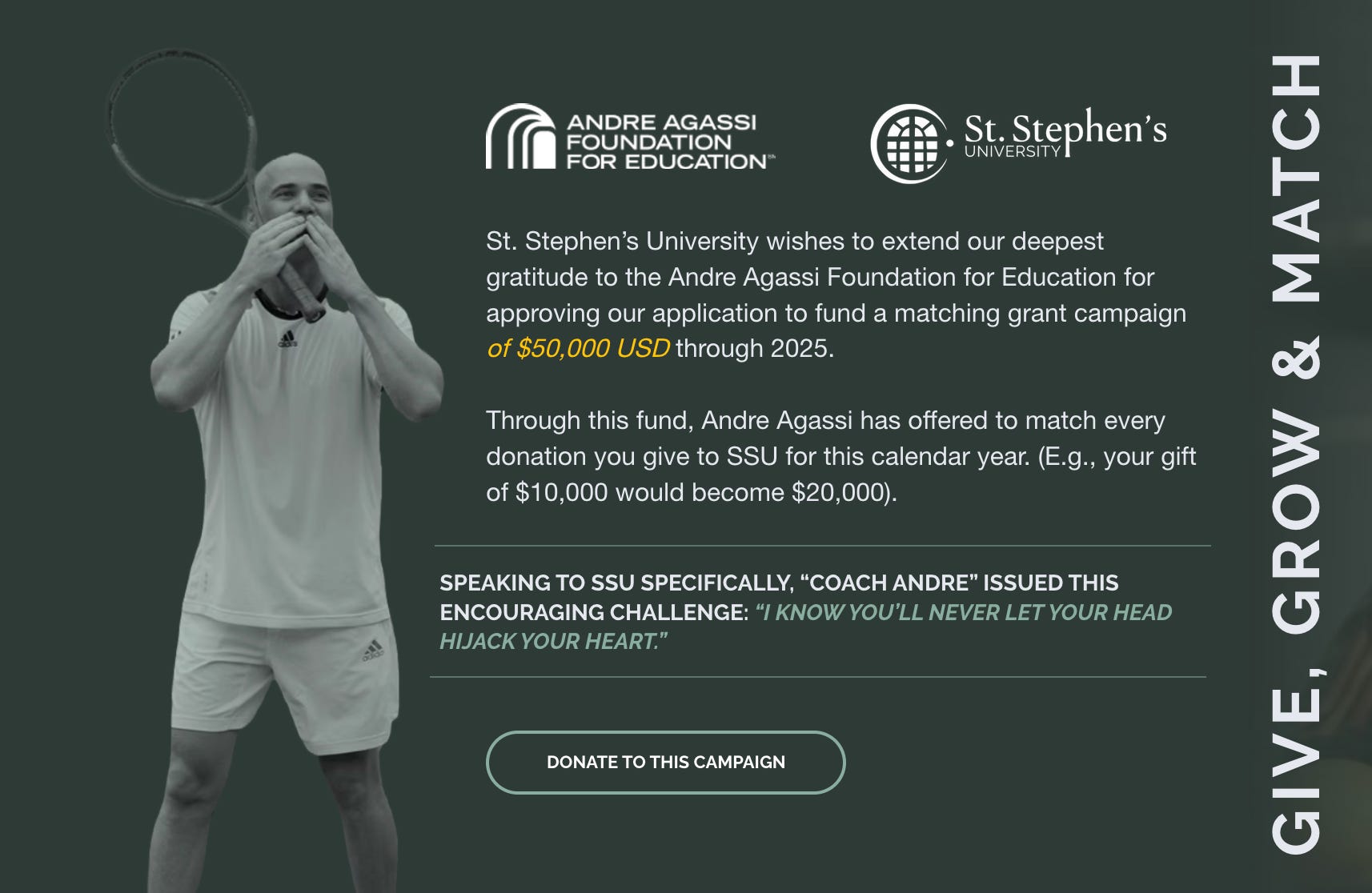
I don’t remember exactly when Wm. Paul Young (The Shack) introduced us, but when I became Principal of St. Stephen’s University, a daunting aspect of the job description was my responsibility for fundraising—a skill for which I have no training, experience, or inspiration. So, knowing that Andre is a master fundraiser, I asked him if he could offer some coaching in how to prepare pitches, etc. He very kindly took me under his wing and even helped create a “Give, Grow & Match” campaign to which he has matched donations to the university dollar-for-dollar.
The first lesson to me and to our school was classic Agassi: he saw an area of strength and challenged me personally and SSU as an institution:
“I know you’ll never let your head hijack your heart.”
It resonated with who we as a school already wanted to be while also calling us to an ongoing way of being.
Around that time, I worried out loud to Andre about whether approaching him on ‘university business’ risked transgressing or compromising the friendship (which I value far more). Here, the personal side of his coaching went “next level.” He said something like this (my paraphrase):
“Don’t compartmentalize what we do as friends from the work we do together. Let everything we do to make the world a better place happen from inside the context of relationship.”
“Agassisms”
After years of FaceTime, phone calls, and texting, I was finally able to meet and hug my friend in person. Over the course of five days, I had the privilege of learning from Andre’s heart and mind. While not an academic, he may be the hardest thinker I know, and he’s adapted his life story (coming soon as an Apple TV docu-series, which he allowed me to preview) into wisdom in my world. I don’t have space to share all that I learned, but from my notes, here are some of highlights from our conversational rallies, in no particular order (blue is him, the rest is commentary that I inferred):
On Regret: “There is a reason why the windshield is larger than the rearview mirror.”
“You can’t coast uphill.”
Andre explained that we don’t simply forget the experiences and lessons of the past, but we’re not so fixated on them that they prevent us from moving forward. Easier said than done when you lose in the French Open finals two years in a row and find yourself staring down that ghost next time you’re there. But he learned and overcame, and I want to learn how to keep moving forward despite what I see in the rearview mirror.
On Attention: “To be Interesting, Be Interested.”
People who are self-absorbed need to be the center of attention and obsess about how to make themselves the most interesting person in the room. In dealing with the pressures and perils of celebrity, Andre learned that genuine attention to the lives and concerns of others unveils just how fascinating everyone we meet actually is. Their stories are worth hearing and drawing out.
On Learning and Teaching: “The day you stop learning is the day you stop teaching… No, let me say that more forcefully: when you stop learning, you’ve already stopped teaching.”
“Answer the questioner, not the question.”
“Stretch their skin while holding their hand at the same time.”
A teacher or coach is not really teaching or coaching if they are simply blasting their expertise on others in ways that don’t land or overwhelm them. It might feel impressive to one’s own ego to wow students with a data dump of information that they can’t absorb. When responding to questions, information isn’t the point. We need to lean into the concerns behind their questions—into the life of that person and what they need. Yes, stretch them, but also accompany them to where they develop “clarity, then conviction, then execution” of what they are learning.
On Life and Faith: “I never see God committing the crime but God’s fingerprints are all over the crime scene.”
Many people have never seen an overt miracle they can cite as “proof” for God. And we don’t need to. But when we carefully examine the flow of our lives, we see evidence of storylines you could never have written. Allow yourself to see those movements as the fingerprints of God.
“We need to move beyond imitation to incarnation.”
In the past, “the imitation of Christ” was a significant theme in discipleship. And emulating others is often not wrong. But the issue with “WWJD?” [What Would Jesus Do?] is that it is still patterned on a model of “separation,” where Christ is an external influence that I try to copy, rather than an indwelling presence whose life becomes incarnate in us.
That’s all for now. But these aphorisms will keep me going and growing for a long time. I’m sure they’ll land for some of my readers.
“We need to move beyond imitation to incarnation.” — Years ago this was my first step towards an emphasis on the inner transformation of a peacemaker (Kempis' ‘Imitation of Christ' was on the right track, but it didn't sit right with me…), recognizing that imitation wasn't enough not just because it took for granted separation between the imitated and the imitator but because imitation without the capacitation was impossible (and engenders frustration that could lead to despair and loss of hope). Capacitation comes through incarnation (who we become instead of what we do), and incarnation — becoming fully and truly human — comes through the contemplative disciplines and ascetic practices (experienced and expressed variously) ... becoming a peacemaker, as a peacemaker on a deeper, essential, ontological level, not just someone who puts on the peacemaker mask to trick God into recognizing them.
Inspirational! Lessons to be repeated many times!